Horticulture & Care
[ planting · soil · water · pruning · propagation · pests ]
Site selection & planting
Plant in fall through early spring, while dormant or just before
bud-break. Beautyberry is forgiving of soil type — sandy loam, sandy clay,
even fairly rocky sites — provided drainage is reasonable and the pH stays
in the 5.5–7.5 range. Choose a spot with at least 4–6 hours
of sun; in deeper shade plants stay vigorous but produce noticeably
fewer fruit. Afternoon shade in west-facing Tulsa exposures helps prevent
mid-summer leaf scorch.
- Hole: 2× rootball width, same depth. Score the rootball if pot-bound.
- Backfill: native soil; light compost is fine but unnecessary.
- Mulch: 2–3" of wood-chip mulch in a 3-ft ring, kept off the trunk.
- Spacing: 4–6 ft on center for a loose hedge; 6–8 ft as specimens.
- Water deeply 1×/week the first growing season, then on rainfall.
Water & soil after establishment
Established beautyberries are notably drought-tolerant in NE Oklahoma but reward
one or two deep soaks during prolonged August–September dry spells with
substantially heavier fruit set. Avoid waterlogged sites; root rot is the most
common cause of decline.
Pruning — the single most important practice
Beautyberry flowers and fruits exclusively on new wood produced
in the current season. The standard practice is to coppice the entire
shrub down to 6–12 inches in late winter (February in Tulsa,
before bud-break), every year or every other year. Hard cut-back produces a
denser, more compact form, much heavier flowering, and the most spectacular fruit
display the following fall. Plants left unpruned for many years become leggy and
sparse, with fruit clusters scattered out at the tips of long arching canes.
Propagation
-
Softwood cuttings: The easiest method. Take 4–6"
cuttings of new growth in late spring/early summer, dip in IBA rooting
hormone (1000–3000 ppm), stick in a sand/perlite mix under intermittent
mist or in a humid dome, and expect 70–90% rooting in 4–6 weeks.
-
Seed: Collect ripe purple fruits September–October.
Macerate, float off pulp, and sow fresh in flats; or scatter directly on
cleared ground in fall and lightly press in. Seeds germinate readily in
spring without elaborate treatment, though a brief cold-moist stratification
improves uniformity.
-
Hardwood cuttings & layering: Both work but are slower
and less reliable than softwood cuttings.
-
Self-seeding: Birds plant beautyberry seedlings throughout
Southeastern gardens; expect (welcome) volunteers near established plants.
Pests & diseases
-
Essentially pest-free. No major insect or disease problems
of horticultural significance. Occasional leaf spots in wet years are
cosmetic.
-
Root rot in poorly drained sites is the principal cause of
landscape failure — site selection prevents it.
-
Deer: Browsed readily, especially when young. Mature plants
in high-pressure areas may need protection until they outgrow browse height;
the woody, hard-pruned crown regenerates well after browse.
Notable cultivars for NE Oklahoma
| Cultivar |
Origin |
Distinguishing feature |
Notes for Tulsa |
| Straight species (wild type) |
SE US native |
Magenta-purple fruit, lavender flowers, 4–8 ft |
The default choice; most genetic diversity, best wildlife value. |
| 'Welch's Pink' |
Texas selection |
Soft pink fruit instead of magenta |
Striking foil for the species form; same vigor and hardiness. |
| 'Lactea' (var. lactea) |
Naturally occurring white-fruited form |
Pure white fruit clusters; pale yellow-green leaves |
Glows in shaded woodland edges; pairs perfectly with the magenta type. |
| 'Russell Montgomery' |
Mississippi nursery selection |
Vigorous white-fruited cultivar |
More uniform fruit set than seed-grown 'Lactea'. |
| 'Berries & Cream' / variegated forms |
Various nurseries |
Cream-margined or splashed foliage |
Less vigorous; best in part shade with afternoon protection. |
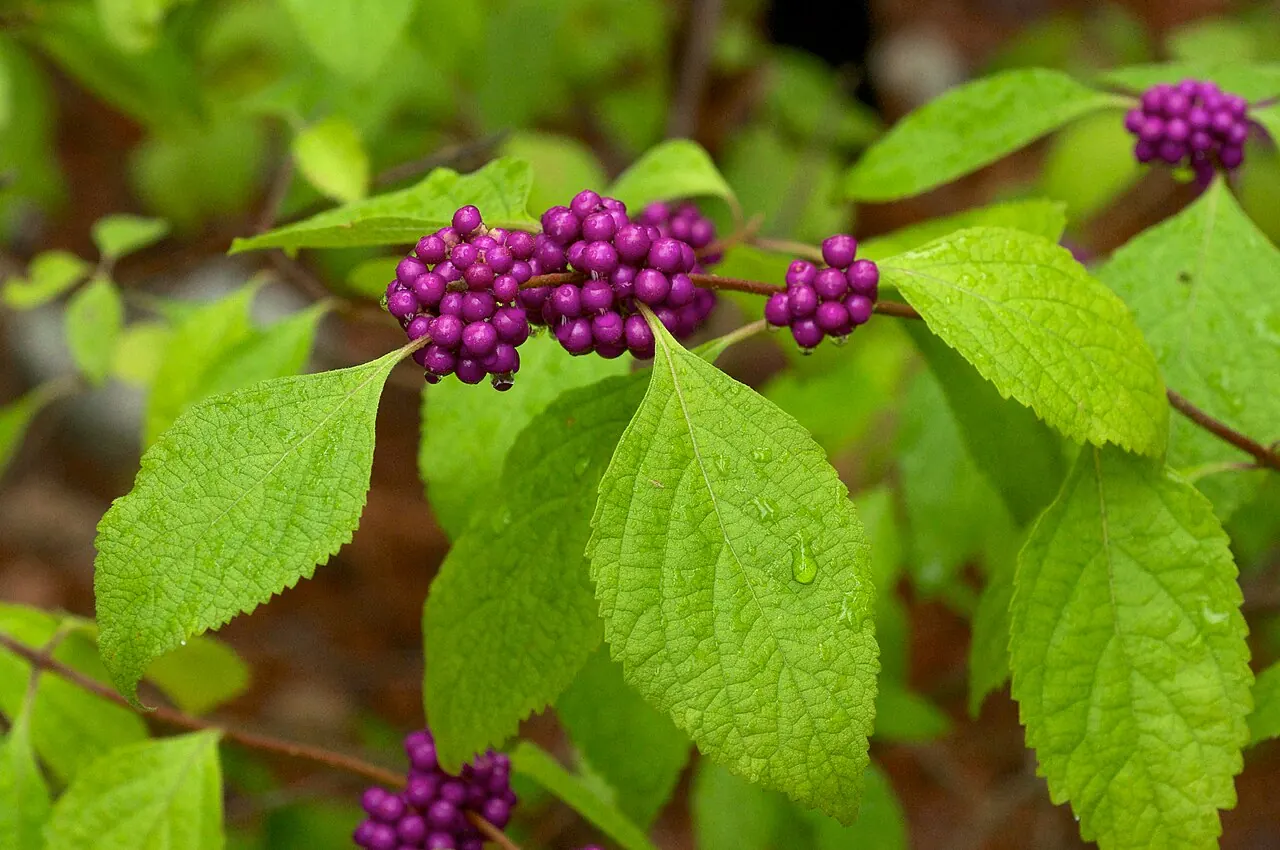
For maximum fall impact: coppice the entire shrub to
6–12 inches every late winter. Beautyberry flowers and fruits only on
current-season wood, so hard cut-back is the single biggest lever for a dense
plant and the heaviest possible display of magenta drupes — the same
clusters that will feed 40+ species of birds from October into
early winter.
Companion planting in a food forest
Layer 4 (shrub layer) in a 7-layer food forest. Plant in the dappled gaps
beneath post oak, blackjack oak, hickory or pecan canopies, paired with
eastern redbud and fragrant sumac at the
shrub edge, and underplanted with aromatic aster,
wild bergamot and little bluestem. The
magenta fall fruit reads beautifully against the gold tones of bluestem and
indiangrass in October.