home/ plants/ common-sunflower

// SPECIES PROFILE · ANNUAL · NATIVE · DOMESTICATE

Common Sunflower

Helianthus annuus

The Common Sunflower is the iconic tall annual of the Great Plains — a native of central North America that turns roadsides, field edges and old pastures across Oklahoma gold from July through September. It is also one of only a handful of major crops domesticated by Indigenous peoples of North America, with cultivated forms appearing in what is now the south-central US and Mexico more than 4,000 years ago. Helianthus annuus is technically an annual, not a perennial, but it self-sows so reliably and supports such an extraordinary cast of specialist pollinators, finches, and seed-eating songbirds that we treat it as the backbone summer flower of any NE Oklahoma food forest or pollinator garden.

// QUICK FACTS
Family
Asteraceae (sunflower / daisy family)
Life cycle
Annual; a tall annual that readily self-seeds
Native range
Central North America — Plains states incl. all of OK, S. Canada → N. Mexico
USDA hardiness
Grown as an annual zones 2–11 (Tulsa = 7a/7b)
Mature size
3–12 ft tall typical; record 35 ft 9 in
Bloom
July – September (NE OK)
Flower head
4–12 in across; yellow rays + brown disk
Sun
Full sun (6+ hrs); leans/lodges in shade
Soil
Any well-drained soil, incl. heavy clay; pH 6.0–7.5
Water
Medium; drought-tolerant once established
State flower
Kansas (1903); native across the entire Great Plains
Wildlife
Specialist solitary bees · checkerspot & painted lady host · finch & sparrow seed
Domesticated
By Indigenous peoples of N. America >4,000 yrs ago
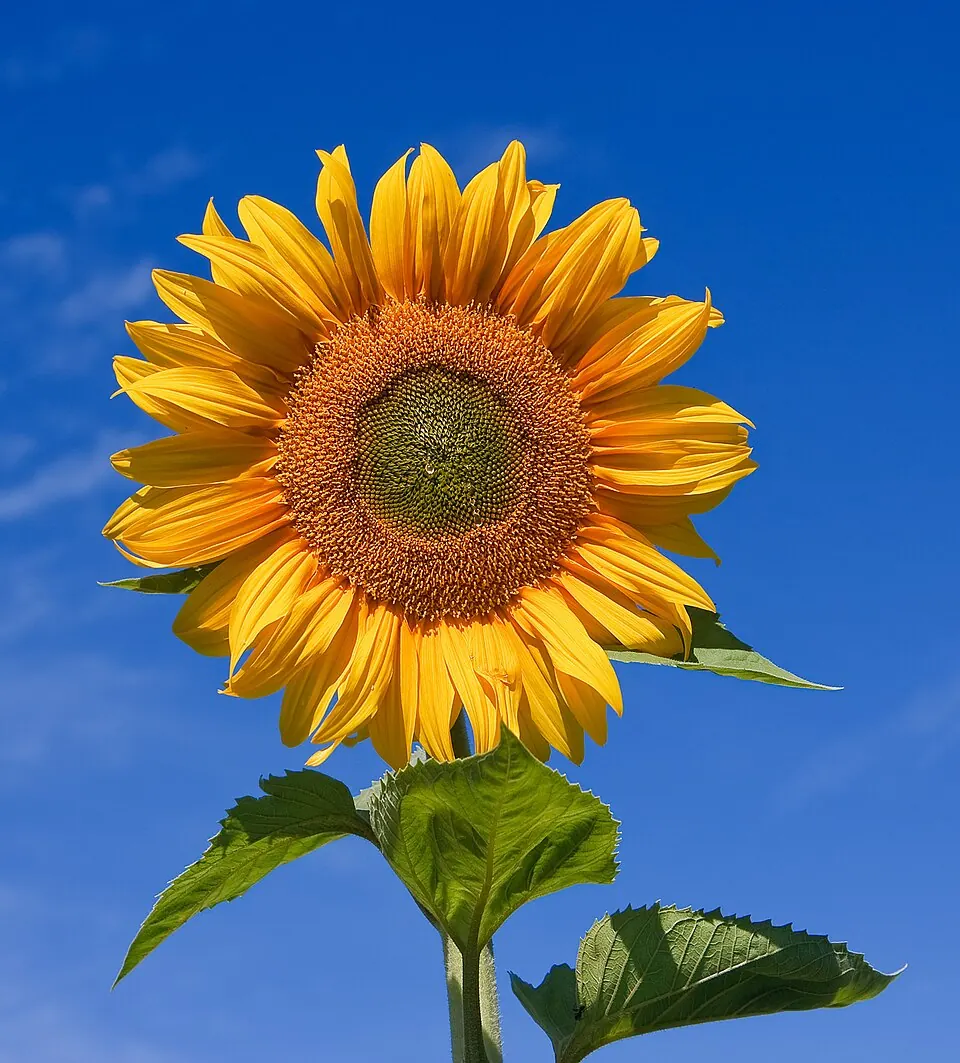
Common Sunflower (Helianthus annuus) head with golden ray florets and brown disk in full bloom
Helianthus annuus in full flower — the composite head is actually hundreds of small florets packed in golden-angle Fibonacci spirals. Photo: Rooted Revival.

Identification

[ field key — stem · leaf · head · seed · habit ]

Habit & Stem

Stout, erect annual herb, typically 3–12 ft tall in the Tulsa region with the tallest cultivars exceeding 15 ft (the Guinness record is over 35 ft). Stem is thick, unbranched in cultivated types and branched in wild plants, covered in short stiff rough hairs that are diagnostic to the touch. Taproot is deep and woody by flowering — one reason mature plants survive Plains drought.

Leaves

Mostly alternate (lower leaves often opposite), simple, broad ovate to heart-shaped (cordate), 4–12 in long, with a coarsely toothed margin and a long petiole. Both surfaces are noticeably rough-hairy (scabrous), like fine sandpaper. The largest leaves sit near the base of the plant; leaves shrink toward the flowering tip.

Flower head

What looks like one giant flower is a composite head (pseudanthium) 4–12 in across (larger in oilseed cultivars). The outer ring of golden-yellow "petals" are sterile ray florets; the brown central disk is hundreds of fertile disk florets arranged in interlocking spirals at the golden angle (~137.5°), producing Fibonacci-numbered spirals (typically 34 + 55 or 55 + 89). Bracts (phyllaries) on the back of the head are broad, ovate, and conspicuously pointed.

Heliotropism & Achenes

Famously "follows the sun" — but only as a young, pre-flowering bud. Immature heads track east-to-west during the day and reset overnight on a circadian rhythm. Once the head opens and matures, it stops moving and stays facing east — warming faster in morning sun and receiving more pollinator visits. The fruits are dry one-seeded achenes (what we casually call "sunflower seeds"), striped or solid black depending on cultivar, ripening late summer through fall.

Habitat & Range in NE Oklahoma

Helianthus annuus is native to central North America, with the wild type common across all of Oklahoma, the Great Plains, the Southwest, and most of Mexico. In NE Oklahoma you will see it nearly anywhere ground has been disturbed: roadside ditches, fence lines, abandoned lots, pastures, field edges, railroad cuts, and any sunny opening in Cross Timbers oak savannah or tallgrass prairie remnant. It is an aggressive pioneer of disturbed soils and germinates readily on bare ground, which is exactly why it shows up in your garden uninvited the year after a tilled bed.

The Common Sunflower has been the state flower of Kansas since 1903, but it is just as much an Oklahoma native — the species' historic core range sits squarely on the Plains, and the strongest evidence for the original domestication event places it in central North America. Outside cultivation it now grows in nearly every part of the world that is not tropical, desert, or tundra.

Ecology & Wildlife Value

[ specialist bees · larval hosts · seed-eating birds · keystone annual ]

Specialist Pollinators

Sunflowers support an unusually large guild of Helianthus-specialist solitary bees — over a dozen North American species feed almost exclusively on Helianthus pollen. Regulars at Tulsa-area plantings include Andrena helianthi (the sunflower miner bee), Diadasia enavata (sunflower chimney bee), Melissodes agilis and other long-horned bees, plus Svastra obliqua. Generalist visitors include honey bees, common eastern bumble bee (Bombus impatiens), American bumble bee (B. pensylvanicus), green sweat bees (Agapostemon), and many beetles and flies.

Lepidoptera Hosts

Larval host plant for several showy butterflies: the silvery checkerspot (Chlosyne nycteis), the gorgone checkerspot (C. gorgone), the bordered patch (C. lacinia), and the wide-ranging painted lady (Vanessa cardui). Numerous moths feed on sunflower foliage and seed heads as well, including the sunflower moth (Homoeosoma electellum).

Birds & Mammals

Mature sunflower heads are one of the most important wild bird food sources of NE Oklahoma fall. American goldfinches are the iconic visitor — you will see flocks clinging upside-down on drying heads from August through October. Also feeding heavily on the achenes: house finches, several sparrows, mourning doves, Northern cardinals, Carolina chickadees, tufted titmice, white-breasted nuthatches, blue jays, and woodpeckers. White- tailed deer browse young plants; squirrels and small mammals raid the heads once seeds ripen.

Soil & Allelopathy

Sunflower roots and leaf litter release allelopathic phenolic compounds (chlorogenic and caffeic acid derivatives) that suppress germination and growth of certain neighboring plants. This is part of why wild sunflowers form dense, near-monocultural stands on disturbed ground. Practical consequence in the garden: don't plant sunflowers in the same spot two years running, and keep them well separated from beans, potatoes, and direct-sown seedlings of small vegetables.

Permaculture role: Tall summer annual / "fourth sister." Several Indigenous farming traditions planted sunflowers along the north edge of the Three Sisters (corn, beans, squash) garden as a wind-break, trellis, and seed crop — effectively a fourth sister. Use the same trick today: a row of sunflowers on the windward side of a vegetable bed gives shade-tolerant crops shelter, attracts pollinators to the whole garden, and feeds finches all winter if you leave the heads standing.

Horticulture & Care

[ direct-sow · soil · water · cultivar selection · allelopathy ]

Site selection & sowing

Sunflowers are absurdly easy. Direct-sow seed after the last spring frost (around April 10–20 in the Tulsa region) into warm, worked soil. Indoor starts are unnecessary and often produce weaker plants because the taproot resents transplanting. Pick a site with at least 6 hours of full sun — less, and stems will lean and lodge under their own weight. Almost any soil will do, including the heavy red clay common around Tulsa, as long as it drains.

Soil, fertility, and rotation

Sunflowers are heavy feeders and will pull notable quantities of nitrogen, phosphorus, and potassium out of the soil over a season. A modest application of compost or balanced organic fertilizer at planting is plenty. Because of both nutrient draw-down and allelopathy, rotate sunflower beds annually — do not plant sunflowers in the same spot in consecutive years.

Pests & diseases

Notable cultivars by purpose

Cultivar Type / use Distinguishing feature Notes for Tulsa
'Mammoth Russian' (a.k.a. 'Russian Giant') Giant single-head 10–12 ft, single 12 in head, large striped seeds Classic kitchen-seed sunflower; heritage variety; needs staking.
'Skyscraper' Giant single-head 12–15 ft, large yellow heads Privacy screen / fence-line backdrop.
'Titan' Giant single-head To 15 ft, very large heads (16 in+) Show plant; needs deep, fertile, mulched soil.
'Autumn Beauty' Branching ornamental Multi-color: gold, bronze, mahogany, bicolor Long bloom; full pollen; excellent pollinator value.
'Velvet Queen' Branching ornamental Deep red-mahogany petals on 5–6 ft branched stems Adds dark color contrast; bees still love it.
'Italian White' (H. debilis hybrid) Branching ornamental Creamy-white rays, dark disk, branched 4–6 ft Elegant cut flower; airy garden presence.
'Lemon Queen' Branching ornamental Soft pale-yellow rays, multi-stemmed, 5–7 ft RHS Award of Garden Merit; very heavy bee visitation.
'Black Oil' Oilseed / bird-seed Single head; thin black hulls; high oil content Basis of commercial bird seed; easy to harvest for backyard feeders.
'Teddy Bear' Dwarf ornamental 2–3 ft, fully double pom-pom heads Container-friendly; pollen-poor — plant alongside true singles.
Pollen-less cultivars and allelopathy — two cautions: Many modern florist sunflowers ('ProCut', 'Sunrich' series, most "pollenless" types) have been bred to shed no pollen, which keeps cut flowers from staining tablecloths but makes them nearly worthless to bees and far less useful to seed-eating birds. If your goal is wildlife value, plant cultivars with normal pollen ('Autumn Beauty', 'Lemon Queen', 'Mammoth Russian', 'Velvet Queen', and any open-pollinated heritage variety). Second: because sunflowers are allelopathic and heavy feeders, rotate their bed every year and avoid planting beans or potatoes immediately downstream.

Companion planting in a food forest

Pairs well with: squash and corn (the Three Sisters + Sunflower "Fourth Sister" arrangement), cosmos, zinnia, and cleome for an extended summer pollinator strip, basil at the base, and any of the warm-season grasses (little bluestem, switchgrass) for a prairie-style massing. Avoid tight interplanting with potatoes, pole beans, and direct-sown root crops because of allelopathy.
Edible & Cultural Uses

The Common Sunflower is, with squash, one of the very few major crops first domesticated in what is now the United States. Cultivated Helianthus annuus with enlarged, single-headed forms appears in the archaeological record at multiple sites: Tabasco, Mexico (~2600 BCE), Tennessee (~2300 BCE), and rockshelter sites in eastern Kentucky — making sunflower part of the Eastern Agricultural Complex alongside goosefoot (Chenopodium berlandieri), little barley, sumpweed, and squash. Hopewell and Mississippian cultures grew sunflower extensively across the Eastern Woodlands and Plains. Indigenous uses included:

A close relative, Helianthus tuberosus (Jerusalem artichoke / sunchoke), is a true perennial sunflower with edible tubers and was also cultivated by Indigenous peoples; it grows happily in NE Oklahoma and is a useful companion species to H. annuus in a perennial food planting.

One of the few crops native to North America. The plants domesticated in eastern and central North America before European contact are a short list: sunflower, squash (Cucurbita pepo), bottle gourd, sumpweed (Iva annua), goosefoot (Chenopodium berlandieri), erect knotweed, maygrass, and little barley. Of these, the Common Sunflower is the only one to have become a globally important commercial crop — a 4,000-year arc from Hopewell garden plot to industrial oilseed.

Photo Reference

Helianthus annuus inflorescence — composite head with golden ray and brown disk florets
// Inflorescence · pseudanthium · ray + disk florets
Wikimedia Commons
Bumblebee foraging on a sunflower head
// Bombus sp. on a sunflower — one of dozens of bee visitors
Wikimedia Commons
Mammoth Russian cultivar of Helianthus annuus, towering single-head sunflower
// Cultivar 'Mammoth Russian' — classic kitchen-seed sunflower
Wikimedia Commons
Sunflower seeds (achenes), dehulled and with hulls
// Achenes (sunflower "seeds") — dehulled (left) & in-hull (right)
Wikimedia Commons
Young Helianthus annuus seedlings emerging from soil
// Seedlings — direct-sown after last frost, germinate in 7–10 days
Wikimedia Commons

Sources & Further Reading

  • USDA NRCS PLANTS Database — Helianthus annuus: plants.usda.gov/plant-profile/HEAN3
  • USDA NRCS Plant Guide — Annual Sunflower (HEAN3), National Plant Data Center, 2000.
  • Lady Bird Johnson Wildflower Center — Native Plant Database: wildflower.org — HEAN3
  • Kansas State University Research & Extension — Sunflower Production Handbook (MF-2384) and related allelopathy / rotation bulletins.
  • University of Nebraska–Lincoln Extension — Sunflower Production (EC150).
  • The Land Institute — Perennial sunflower breeding program (context for ongoing efforts to develop a perennial oilseed Helianthus): landinstitute.org
  • Atamian, H.S. et al. (2016). Circadian regulation of sunflower heliotropism, floral orientation, and pollinator visits. Science 353(6299):587–590 — the definitive paper on heliotropism stopping at maturity.
  • Blackman, B.K. et al. (2011). Sunflower domestication alleles support single domestication center in eastern North America. PNAS 108(34):14360–14365.
  • Lentz, D.L. et al. (2008). Sunflower (Helianthus annuus L.) as a pre-Columbian domesticate in Mexico. PNAS 105(17):6232–6237.
  • Smith, B.D. (2006). Eastern North America as an independent center of plant domestication. PNAS 103(33):12223–12228 — on the Eastern Agricultural Complex.
  • Wikipedia — Common sunflower: en.wikipedia.org/wiki/Common_sunflower (CC BY-SA 4.0; portions of the description, ecology and uses sections summarize Wikipedia content).
  • Jarrod Fowler & Sam Droege — Pollen Specialist Bees of the Eastern United States (specialist bee lists for Helianthus).

Hero photo: Rooted Revival. Strip photos courtesy of Wikimedia Commons contributors under their respective licenses (linked under each image).