home/ plants/ osage-orange

// SPECIES PROFILE · TREE · NATIVE (S. OK)

Osage Orange

Maclura pomifera

Known to French traders as bois d'arc (pronounced "bo-dark" in Oklahoma — and corrupted to bodark, bodock, or bodarc), Osage Orange is the thorny, deeply furrowed, orange-wooded tree behind nearly every old fence row in NE Oklahoma. Its tiny pre-Columbian native range was the Red River drainage of southern OK, north TX, and SW AR, making southeast Oklahoma the heart of its true homeland. Prized by the Osage, Comanche, and Pawnee for its incomparable bow wood, then planted by the wagonload across the Great Plains as the original "horse-high, bull-strong, hog-tight" living fence before barbed wire, Maclura pomifera is a tree that has shaped Plains history more than almost any other native species.

// QUICK FACTS
Family
Moraceae (mulberry family)
Native range
Red River drainage: S. OK, N. TX, SW AR; Texas Blackland Prairie & post-oak savanna
Now naturalized
All 48 contiguous US states + S. Ontario
USDA hardiness
Zones 4–9 (Tulsa = 7a/7b)
Mature size
30–50 ft tall · 30–40 ft spread
Growth rate
Fast: 1–2 m of new shoot per year
Lifespan
75–150+ yrs (oldest known: ~350 yrs, VA)
Sex
Dioecious — only female trees fruit
Bloom
May — inconspicuous green
Fruit
Sept–Oct; 10–13 cm yellow-green syncarp
Sun
Full sun (intolerant of shade)
Soil
Any — clay, sand, rocky, alkaline; pH 5.5–8.5
Water
Extremely drought-tolerant once established
Wood
Janka 11.64 kN; densest, most rot-resistant N. American hardwood
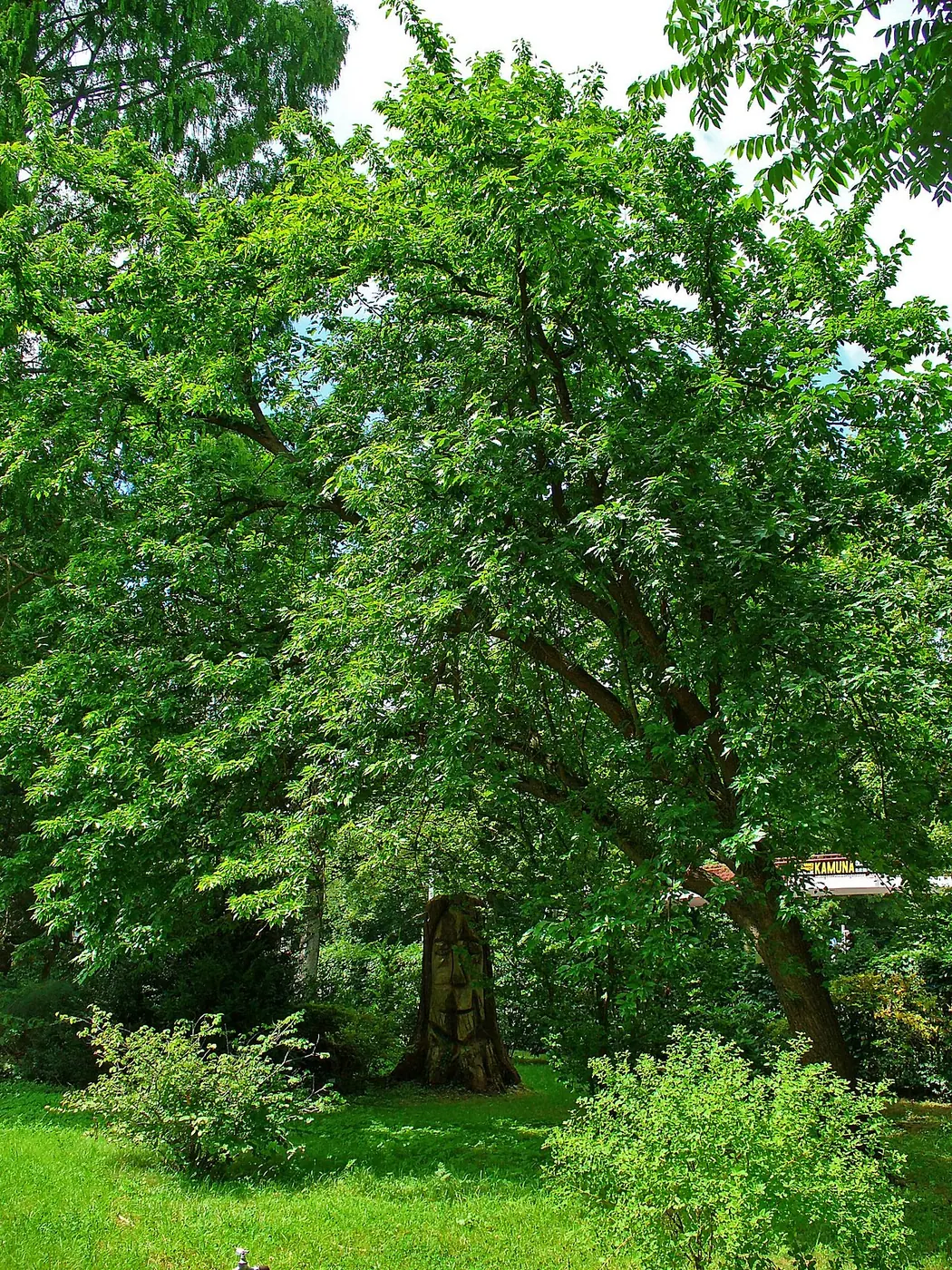
Mature Osage Orange (Maclura pomifera) tree with broad rounded crown in summer foliage
A mature Maclura pomifera in full summer foliage — the broad, rounded crown typical of an old fence-row specimen. Photo via Wikimedia Commons (CC BY-SA).

Identification

[ field key — bark · leaf · thorn · fruit · habit ]

Habit & Bark

Small to medium tree, typically 30–50 ft with a short, often leaning trunk and a broad, irregular, round-topped crown. Bark on mature trees is deeply furrowed and scaly, dark orange-brown to nearly black on the ridges. Slice into a fresh trunk and the freshly cut wood is a startling bright golden-yellow that fades to medium brown with sun exposure. Roots are thick and fleshy with their own bright orange bark — a useful field ID for stump suckers.

Leaves & Thorns

Leaves alternate, simple, ovate-acuminate (long oval ending in a slender drawn-out point), 8–13 cm long × 5–8 cm wide, thick, firm, glossy dark green above and paler below. Margins entire. Turn clear yellow in October. Cut a leaf or twig and a sticky milky latex oozes out — a key Moraceae family trait shared with mulberry and figs. Each leaf axil bears a stout, straight, sharp axillary spine 1–3 cm long — not a modified branch but a true spine.

Flowers (Dioecious)

Pale green and easy to miss, opening in May after the leaves. Maclura is strictly dioecious: male and female flowers occur on separate trees. Staminate (male) flowers hang in slender, drooping racemes from the previous year's spur shoots. Pistillate (female) flowers form a dense, spherical, many-flowered head about the size of a marble at the leaf axil — the future hedge apple. Wind-pollinated. You will only ever see fruit on a female tree.

Fruit (Syncarp) & Seeds

The famous "hedge apple" or "horse apple": a multiple fruit (syncarp) formed when many small drupes from a single female head fuse together. 8–15 cm across, roughly grapefruit-sized, yellow-green, with a deeply warty, brain-like surface. Bleeds copious sticky white latex when cut. Each syncarp contains hundreds of small oblong seeds embedded in a dense, fibrous, faintly cucumber-scented pulp. Drops in September–October and lies on the ground largely uneaten — the central ecological puzzle of the species (see below).

Habitat & Range in Oklahoma

Osage Orange has the unusual distinction of being both a true Oklahoma native with a tiny pre-Columbian range and one of the most widely planted hedge trees in American history. Its original natural range was the Red River drainage of what is now southern Oklahoma (McCurtain, Choctaw, Bryan, Love, Marshall, Carter, Jefferson and Cotton counties), northern Texas, and southwestern Arkansas, plus the Texas Blackland Prairies and post-oak savanna, with a disjunct population in the Chisos Mountains. Southeast Oklahoma is the core of its true homeland.

Across NE Oklahoma — including Tulsa, Rogers, Wagoner, Mayes, Creek, Osage and Washington counties — Osage Orange is not strictly native, but is now thoroughly naturalized. Almost every old farmstead in our region has a line of bois d'arcs along an abandoned fence row. These trees are the surviving remnants of two waves of intentional planting: the 19th-century "living fence" craze before barbed wire (1850s–1870s) and the federal Great Plains Shelterbelt program of the 1930s, which planted 220 million trees — with Maclura as one of the most-used species — across the Dust-Bowl states. Today it grows comfortably on any well-drained Oklahoma site, from rocky sandstone uplands to deep alluvial bottoms.

Ecology & Wildlife Value

[ Pleistocene anachronism · seed dispersal · cavity & thorn nesters ]

The Pleistocene Anachronism

The hedge apple is the textbook example of an evolutionary anachronism, a hypothesis proposed by Daniel H. Janzen and Paul S. Martin in 1982: a fruit so large, hard, and unappetizing to modern wildlife that it appears to have coevolved with seed dispersers that are no longer here. The candidate dispersers are the Pleistocene megafauna — ground sloths, mammoths, mastodons, gomphotheres, and a now-extinct American horse — all of which vanished roughly 10,000 years ago. With its dispersers gone, Maclura's native range collapsed to the small Red River relict pocket where humans found it 200 years ago. The hypothesis remains debated: 2015 and 2018 studies found extant horses and squirrels to be poor dispersers, and some researchers call the story a "just-so" narrative lacking direct evidence.

What Actually Eats the Fruit Today

Very little. Fox squirrels are the most consistent users: they tear open fallen syncarps to extract the small oily seeds, leaving distinctive shredded "fruit-pulp middens" beneath the tree. White-tailed deer in the Midwest, black-tailed deer in Texas, and occasionally cattle and horses will consume whole or broken fruits. Crossbills peck seeds from cracked-open hedge apples. The fact that most of the fruit crop sits intact on the ground all winter is itself the strongest field evidence for the anachronism hypothesis.

Birds, Cover & Nesting

The dense thorny canopy is excellent cover and nest habitat for songbirds — especially in open prairie country where it functions as the only available tall woody cover. The Loggerhead Shrike (a declining grassland bird in much of N. America) regularly nests in Maclura and famously uses its thorns as a "larder," impaling prey items — grasshoppers, lizards, mice — on the spines for later consumption. Cavity-nesting birds use older hollow trunks.

Pests, Disease & Soil Function

Osage Orange is famously almost free of insect pests and fungal disease, owing to high concentrations of the isoflavones osajin and pomiferin (4–6% of dry weight in wood and fruit) that act as natural antifungals and antifeedants. It is not a nitrogen fixer. As a windbreak species it moderates wind speed, reduces soil erosion, and shelters understory biodiversity — its foundational role in the 1934 Shelterbelt program. Heavy leaf litter is slow to decompose due to the same isoflavones.

Permaculture / regenerative role: A windbreak / shelterbelt / living-fence species par excellence. Plant on the windward edge of a property, coppice on a 5–10-year cycle for an endless supply of rot-proof fence posts, and use as the thorny hedge layer of a mixed-species shelterbelt with bur oak, chickasaw plum, and persimmon. Plant only thornless males (see cultivars below) anywhere within reach of foot traffic, livestock, or anywhere you don't want fallen hedge apples to deal with.

Horticulture & Care

[ planting · soil · water · propagation · coppicing · cultivars ]

Site selection & planting

Osage Orange is one of the toughest trees in North America. It demands full sun and is intolerant of shade, but otherwise will thrive in nearly any soil — heavy red Oklahoma clay, rocky sandstone, deep alluvium, and even modestly saline or alkaline ground are all acceptable. Plant 1–3-gallon container stock or bare-root whips in late winter (February–early March in Tulsa) while still dormant. Young trees transplant easily; older trees do not. Space living-fence rows 1–2 ft apart, shelterbelt specimens 10–20 ft apart.

Water, drought & tolerance

Once established, Maclura is among the most drought-tolerant trees in our region. Its deep, fleshy taproot reaches groundwater that other trees cannot, which is why old bois d'arcs survive in fence rows decades after the surrounding cottonwoods and elms have died. It also tolerates compacted urban soil, ice-storm damage (sprouts vigorously from the base), occasional flooding, and prairie fire.

Pruning & coppicing

Prune in late winter while dormant. Osage Orange is one of the premier coppice species in the temperate world — cut a stem to the ground and it will resprout multiple vigorous shoots that grow 1–2 m in a single season. A traditional Plains hedge management cycle is to coppice every 5–10 years for a continuous supply of fence-post-grade saplings. For a living fence, prune the tops aggressively and weave the shoots horizontally ("plashing") to create an impenetrable thorn wall.

Propagation

Pests & diseases

Notable cultivars & uses

Cultivar Sex / thorns Distinguishing feature Notes for Tulsa & the Plains
'Whiteshield' Male, thornless Selected at the Kansas State Univ. PMC; vigorous symmetrical crown The most widely available thornless cultivar; ideal urban shade tree, no fruit, no spines.
'Wichita' Male, thornless Glossy dark foliage, dense rounded crown Excellent shelterbelt & street-tree selection for the Southern Plains.
'Park' Male, thornless Upright spreading habit, fast growth Park / boulevard tree where a tough, fruit-free native is needed.
'Inermis' Variable, thornless European clone (the inermis = "unarmed" form) Older garden form widely planted in European botanic gardens.
Wild seedling, female Female, thorny Produces full hedge-apple crop annually What you have if a "volunteer" Osage came up in your fence row; keep for wildlife / windbreak / firewood / fence posts.
Wild seedling, male Male, thorny No fruit, full thorns Excellent firewood / coppice / windbreak; will not litter the ground with hedge apples.
Caution — the thorns are serious. Mature Osage Orange spines are 1–3 cm long, straight, sharp, and stout enough to easily puncture leather gloves and tractor tires. Puncture wounds from Maclura thorns are notorious for becoming infected. Always wear heavy leather gauntlets, eye protection, long sleeves and sturdy boots for any pruning, coppicing, or hedge management. Never burn or shred fresh trimmings without long sleeves — the spines remain hazardous well after the wood has dried.
Cultural & Material Uses

Few trees in North America have a deeper material-culture history than Osage Orange. Almost every traditional use revolves around the same astonishing properties of its wood: extreme density (~62 lb/ft³, specific gravity 0.77), Janka hardness 11.64 kN (nearly twice white oak), and natural rot resistance equal to cedar or black locust.

Photo Reference

Maclura pomifera — flowering habit
// Maclura pomifera — flowering habit
Maclura pomifera — foliage & form
// Maclura pomifera — foliage & form

Sources & Further Reading

  • USDA NRCS PLANTS Database — Maclura pomifera: plants.usda.gov/plant-profile/MAPO
  • Wynia, R. L. (2011). Plant Fact Sheet: Osage orange (Maclura pomifera). USDA NRCS Manhattan Plant Materials Center, Kansas: fs_mapo.pdf
  • USDA Forest Service Fire Effects Information System (FEIS): fs.usda.gov/database/feis/plants/tree/macpom
  • Burton, J. D. (1990). Maclura pomifera. In Burns & Honkala, eds., Silvics of North America, Vol. 2: Hardwoods. USDA Forest Service: srs.fs.usda.gov — Silvics
  • Lady Bird Johnson Wildflower Center — Native Plant Database (Maclura pomifera): wildflower.org — MAPO
  • Boggs, J. (2021). Bois D'Arc. Buckeye Yard & Garden Online, Ohio State University Extension: bygl.osu.edu/node/1884
  • Barlow, C. (2001). Anachronistic Fruits and the Ghosts Who Haunt Them. Arnoldia 61(2): 14–21 (Arnold Arboretum, Harvard).
  • Boone, M. J. et al. (2015). A Test of Potential Pleistocene Mammal Seed Dispersal in Anachronistic Fruits. Southeastern Naturalist 14(1): 22–32.
  • Murphy, S. et al. (2018). Seed Dispersal in Osage Orange (Maclura pomifera) by Squirrels (Sciurus spp.). American Midland Naturalist 180(2): 312–317.
  • Smith, J. L. & Perino, J. V. (1981). Osage Orange (Maclura pomifera): History and Economic Uses. Economic Botany 35(1): 24–41.
  • Wikipedia — Maclura pomifera: en.wikipedia.org/wiki/Maclura_pomifera (CC BY-SA 4.0; portions of the description, history and uses sections summarize Wikipedia content).

Photos courtesy of Wikimedia Commons contributors under their respective licenses (linked under each image).

Companion Planting

[ guild · polyculture · cross-layer pairings ]

In a hedgerow or thicket, osage orange pairs naturally with: chickasaw plum (Prunus angustifolia), crossvine (Bignonia capreolata), eastern redcedar (Juniperus virginiana), fragrant sumac (Rhus aromatica), maypop / passionflower (Passiflora incarnata), and downy hawthorn (Crataegus mollis).

osage orange works best as a canopy or sub-canopy partner above the herbaceous and shrub layers.