home/ plants/ pecan

// SPECIES PROFILE · TREE · NATIVE

Pecan

Carya illinoinensis

The largest native hickory in North America and the iconic bottomland tree of NE Oklahoma's river valleys — the Arkansas, Verdigris, Caney, Grand and Red — Carya illinoinensis built the alluvial forests our farms and towns were carved out of. Native pecan groves still line the lower Verdigris and Arkansas, and improved orchards across the eastern half of the state make Oklahoma a top-ten U.S. producer. Often confused with its southern neighbor: pecan is the state tree of Texas (since 1919), while Oklahoma's state tree is the eastern redbud (since 1937) — though pecan pie is enshrined as part of the official Oklahoma state meal. Slow to bear, generous when it does, and one of the few crops you can plant for your grandchildren that also feeds every squirrel, woodpecker and wild turkey for a quarter-mile.

// QUICK FACTS
Family
Juglandaceae (walnut family)
Native range
South-central U.S. & N. Mexico; Mississippi/Arkansas/Red River bottoms east into IL, IN, KY; native NE OK along Verdigris, Caney, Arkansas & Grand rivers
USDA hardiness
Zones 5–9 (Tulsa = 7a/7b)
Mature size
66–131 ft tall · 39–75 ft spread; trunk to 6+ ft DBH
Growth rate
Moderate; ~16 ft at 10 yrs in good bottomland
Lifespan
200–300+ yrs; productive 75–150 yrs
Bearing age
Grafted: 6–10 yrs · Seedling: 10–20 yrs
Bloom
Late April – mid May (NE OK); wind-pollinated
Harvest
Mid October – late November
Sun
Full sun (8+ hrs); will not bear in shade
Soil
Deep, well-drained loam or alluvium; pH 6.0–7.5
Water
High during nut fill (Jul–Sep); 1–2 in/wk equivalent
Spacing
60–80 ft on center for full-sized orchard trees
Pollination
Dichogamous (Type I or Type II); needs cross-pollinator
Wildlife
Mast for squirrels, deer, turkey, crow, woodpeckers, wood ducks
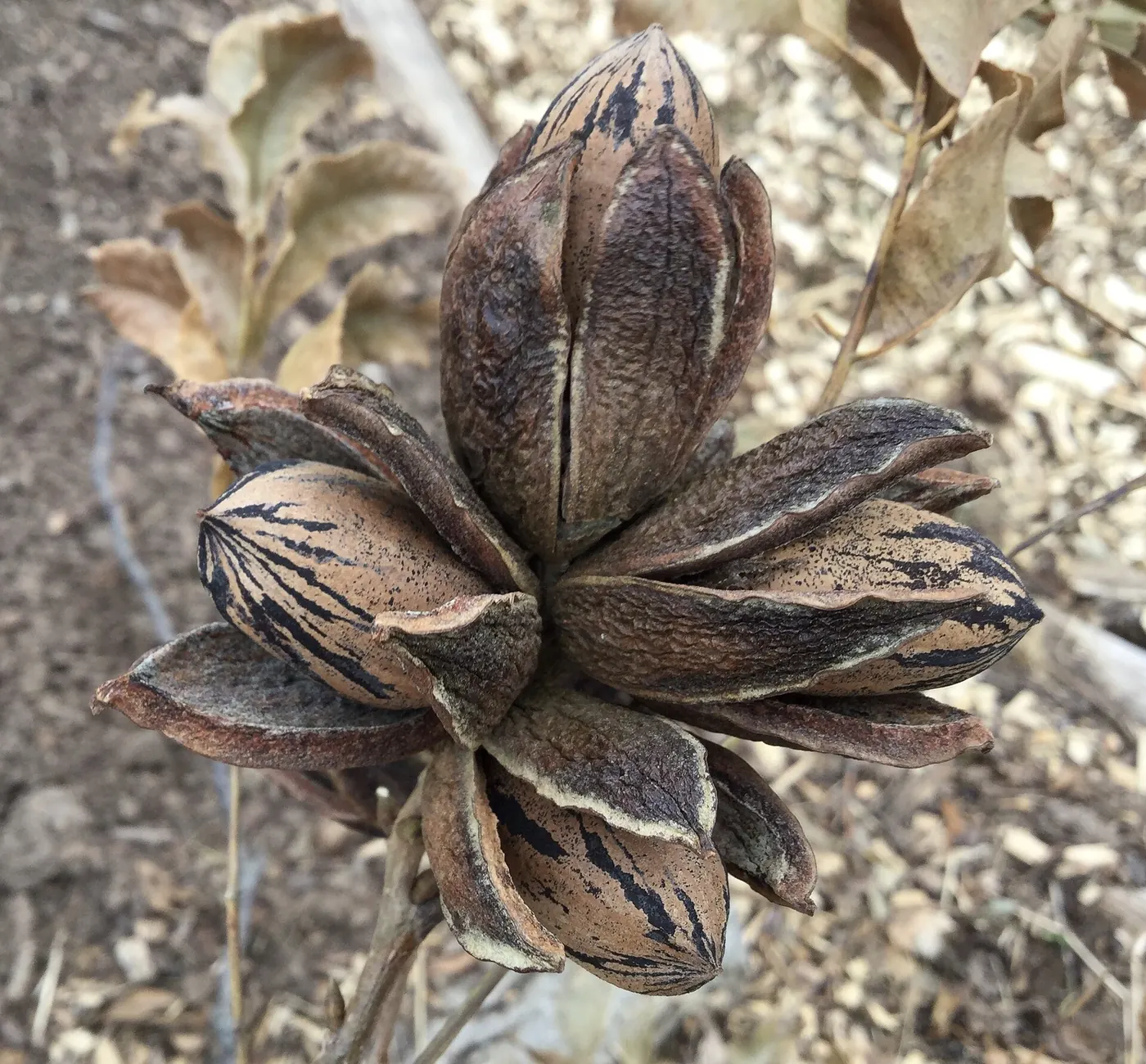
Carya illinoinensis — cluster of pecan fruit with husks split open at maturity, revealing the thin-shelled nuts
A cluster of Carya illinoinensis nuts at maturity, husks dehiscing along four sutures — the classic October sight in NE Oklahoma bottomland groves. Photo: Wikimedia Commons.

Identification

[ field key — bark · leaf · flower · fruit · habit ]

Habit & Bark

Massive deciduous tree with a single straight bole and a broad, open, vase-shaped to rounded crown when grown in the open; bottomland forest specimens grow tall and clean. Mature bark is light gray-brown, deeply furrowed into narrow, scaly, interlacing ridges — coarser and flatter than shagbark hickory, never exfoliating in long strips. Twigs stout, reddish-brown, with prominent chambered (not solid) pith — a diagnostic feature shared with walnut. Buds yellow-brown, valvate (overlapping like a clamshell), not scaly like other hickories.

Leaves

Alternate, odd-pinnately compound, 30–45 cm (12–18 in) long with 9–17 leaflets (most often 11–13). Leaflets lanceolate, falcate (curved like a sickle), 5–12 cm long, finely serrate, tapering to a long point; the terminal leaflet is often asymmetrical and may be reduced. Dark yellow-green above, paler beneath, turning yellow to yellow-brown in late October. The curving, sickle-shaped leaflets are the fastest field ID versus mockernut or shagbark hickory.

Flowers

Wind-pollinated and monoecious — both sexes on the same tree but separated. Male flowers in slender, pendulous yellow-green catkins 8–18 cm long, hanging in threes from old wood. Female flowers tiny, in short erect spikes at the tips of new shoots, with feathery yellow-green stigmas. Crucially, an individual tree is dichogamous: male and female flowers mature at different times, so a tree can rarely pollinate itself effectively (see Horticulture).

Fruit (Nut & Husk)

Botanically a drupe, not a true nut. Oblong to ellipsoidal, 2.6–6 cm long, in clusters of 3–11. The outer husk (developed from bracts and bracteoles, 3–4 mm thick) starts brassy green, dries brown, and splits cleanly along four sutures in October to release the seed. The seed itself is the familiar pecan: thin-shelled, oblong, with two deeply convoluted cotyledons rich in oil (~72% fat by mass).

Habitat & Range in NE Oklahoma

Pecan's native distribution centers on the Mississippi River drainage — from southern Iowa and Illinois south through Missouri, Arkansas, Louisiana, eastern Texas, and into northeastern Mexico. The species reaches its northwestern native limit in eastern Oklahoma, where it follows the major bottomlands of the Arkansas, Verdigris, Grand (Neosho), Caney, Canadian and Red rivers. Native pecan groves — many over a century old — are still actively harvested in counties from Mayes and Wagoner south through Muskogee, Sequoyah, Pittsburg and McCurtain.

Pecan is a true bottomland species: it wants deep, fertile, well-drained alluvial soils with a high water table but not standing water. It tolerates occasional spring flooding while dormant but not prolonged saturation during the growing season. On the rocky uplands of the Cross Timbers and the Ozark plateau it survives but rarely thrives or bears well; the Tulsa-area sites that produce reliable pecan crops are old river-terrace soils, deep loess, or amended bottoms along Bird Creek, Mingo Creek and the Arkansas. Statewide, Oklahoma harvests both native seedling pecans (small, intensely flavored, used for baking) and improved grafted cultivars (larger, thinner shells, sold as in-shell or shelled premium nuts).

Ecology & Wildlife Value

[ pollinators · mast consumers · cavity nesters · trophic role ]

Mast & Mammals

Pecan is one of the highest-value hard-mast trees in NE Oklahoma forests. Fox squirrels, gray squirrels, raccoons, opossums, white-tailed deer, black bear (in the southeast), and feral hogs all feed heavily on dropped nuts. A single mature tree can produce 50–200+ lbs of nuts in a good year, fueling the boom-and-bust population cycles of bottomland squirrels and the wildlife that depends on them.

Birds

Wild turkey, crow, blue jay, red-headed and red-bellied woodpeckers, and wood ducks all consume pecans — jays and woodpeckers in particular cache them and inadvertently plant the next generation. Mature trunks with heart-rot are prime cavity nest sites for pileated woodpeckers, screech owls, wood ducks and barred owls. The catkin pollen pulse in early May coincides with songbird nesting.

Insects & Specialists

Pecan hosts a specific guild of insects evolved on the genus Carya: pecan weevil (Curculio caryae), hickory shuckworm (Cydia caryana), pecan nut casebearer, pecan phylloxera, twig girdlers, and the regal moth (Citheronia regalis) whose enormous "hickory horned devil" caterpillar feeds on the foliage. Most are problematic only at orchard densities; in a mixed landscape they are part of a functional food web.

Soil & Forest Function

Like its cousin black walnut, pecan produces juglone (5-hydroxy-1,4-naphthoquinone) in its roots, leaves and husks — but at significantly lower concentrations than Juglans nigra. Sensitive species (tomatoes, blueberries, rhododendrons, apples) may struggle within the dripline, but the allelopathic zone is much narrower and most native understory plants coexist freely. Deep taproot draws minerals from below the rooting zone of grasses, returning them in autumn leaf-fall.

Permaculture role: Layer 1 (canopy / overstory) in a 7-layer food forest — the long-lived high-value nut crop. Plan the system around it: 60–80 ft spacing, full sun, deep alluvial soil. Pair with shade-tolerant understory layers of pawpaw, persimmon, elderberry, and currants/gooseberries; avoid juglone-sensitive crops within the dripline. Native pecan groves in eastern OK are themselves a model silvopasture — cattle graze the ground story while the canopy delivers the cash crop.

Horticulture & Care

[ planting · soil · water · pollination · pruning · pests ]

Site selection & planting

Pecan demands full sun, deep soil and elbow room. Choose a site with at least 4 ft of rootable soil over a non-restrictive subsoil (no caliche pan, no perched water table). Plant bare-root, dormant nursery stock in late winter (February in Tulsa), before bud break. Container stock can go in fall through early spring. Pecans have a deep, brittle taproot — transplanting older trees almost always fails. Buy young, plant young.

Pollination — the dichogamy problem

A single pecan tree will almost never pollinate itself well. Every cultivar is classified by when its male and female flowers mature:

Plant at least one of each type within ~150 ft to guarantee a full crop. A common Oklahoma backyard combination is 'Pawnee' (Type I, early) + 'Kanza' (Type II, scab-resistant) — a pair that covers both flowering windows and brings two complementary harvest dates.

Water & nutrition

Pecan is a thirsty tree. Mature orchard trees can transpire 200–350 gallons per day at peak summer demand. The critical window is kernel fill, July through September — water stress here aborts nuts, shrivels kernels and triggers severe alternate bearing. Aim for ~1.5–2 inches of water per week from rainfall plus irrigation during this window. Drip or microsprinklers under the canopy are far more efficient than overhead.

Zinc deficiency is nearly universal on Oklahoma soils and shows as "rosetting" — small, distorted, bunched leaves at shoot tips. Apply zinc sulfate (NZN or zinc EDTA) as a foliar spray every 2–4 weeks from bud break through early summer. Soil applications of zinc are largely wasted on our pH 7+ alkaline soils. Nitrogen at 1 lb actual N per inch of trunk diameter, split between February and June, is a standard OSU recommendation; avoid urea on young trees prone to nickel-induced "mouse-ear."

Pruning

Pecan naturally forms a vase-shaped canopy and needs little structural pruning — the OSU recommendation is to remove only dead, diseased, broken or crossing limbs. Prune in late winter while dormant. On young trees, train to a single central leader for the first 5–8 years, then let the natural crown develop. Avoid heavy heading cuts; pecan responds with weak, watersprout regrowth.

Pests & diseases

Recommended cultivars for NE Oklahoma

Cultivar Pollination type Distinguishing feature Notes for Tulsa
'Pawnee' Type I (protandrous) Early ripening (mid-Sept), large nuts, ~57% kernel OSU-recommended workhorse; ripens before first frost; moderate scab susceptibility — spray-dependent in wet years.
'Kanza' Type II (protogynous) Small-medium nut, excellent kernel quality, very low alternate bearing USDA release; excellent scab resistance; cold-hardy; the top choice for low-spray home orchards in OK.
'Lakota' Type II (protogynous) Medium-large nut, ~57% kernel, strong limb structure USDA release with strong scab resistance; resists wind breakage common with weaker cultivars.
'Maramec' Type II (protogynous) Large nut, ~58% kernel, bred at OSU Oklahoma-bred selection; large nut size; moderate scab pressure — best on drier sites.
'Oconee' Type I (protandrous) Large nut, ~56% kernel, southern-adapted Performs in southern OK; pair with a Type II like 'Kanza' for pollination.
'Caddo' Type I (protandrous) Small-medium nut, very high kernel %, precocious Begins bearing young; good scab tolerance; consistent producer.
'Mohawk' Type II (protogynous) Very large nut, vigorous tree Showy "yard-tree" cultivar; alternate bears strongly; not for low-input sites.
Native seedling Variable Small, dark, intensely flavored nut; thick shell Backbone of OK's native pecan industry — long-lived, low-input, ideal for silvopasture and wildlife.
The patience tax: Even grafted pecans take 6–10 years to begin bearing and 12–15 years to reach meaningful production. Seedlings often need 15–20+ years. Plant pecan because you want a 200-year tree on your land — not because you want nuts next season. For faster nuts, plant a hazelnut or chestnut alongside.

Companion planting in a food forest

Pecan is the canopy. Beneath it, plant juglone-tolerant species: pawpaw (Asimina triloba) and American persimmon in the small-tree layer; elderberry, black raspberry, currants and gooseberries in the shrub layer; wild ginger, solomon's seal, ostrich fern and native woodland sedges in the herbaceous layer. Avoid apples, blueberries, tomatoes, potatoes, peppers and rhododendrons within the dripline.
Edible, Cultural & Material Uses

Few North American trees match the pecan for sheer breadth of use — food, oil, wood, smoke, dye, and cultural identity in the Southern U.S.

The Tulsa connection: Oklahoma typically ranks in the top 5–8 U.S. pecan-producing states by volume, with most production east of I-35. Native pecan harvest is a multi-generation rural tradition along the Verdigris and Arkansas; the OSU pecan breeding program at Perkins released 'Maramec', 'Pawnee' (a USDA release tested heavily in OK), and several others specifically for our climate.

Photo Reference

Carya illinoinensis — cluster of immature green pecan fruits on the branch in summer
// Immature fruit cluster · green husks · summer
Wikimedia Commons
Carya illinoinensis valvate yellow-brown buds and twig in winter
// Valvate bud · stout twig · chambered pith
Wikimedia Commons
Shelled and unshelled pecan nuts in a bowl
// Nuts shelled & in-shell · the harvest
Wikimedia Commons
Pecan seedling sprouting from moist wood-chip mulch in eastern Oklahoma
// Seedling · sprouting in mulch · eastern Oklahoma
Wikimedia Commons

Sources & Further Reading

  • USDA NRCS PLANTS Database — Carya illinoinensis: plants.usda.gov/plant-profile/CAIL2
  • Moore, L. M. (2006). Plant Guide: Pecan, Carya illinoinensis. USDA NRCS, Baton Rouge, LA.
  • Oklahoma State University Extension — Pecan Production (HLA-6232) and Pecan Variety Recommendations for Oklahoma.
  • Oklahoma Cooperative Extension — Improving Native Pecan Groves (E-1009).
  • USDA-ARS Pecan Breeding (Brownwood & College Station, TX) cultivar profiles — aggie-horticulture.tamu.edu/carya
  • Lady Bird Johnson Wildflower Center — Native Plant Database, Carya illinoinensis: wildflower.org — CAIL2
  • Flora of North America — Carya illinoinensis: efloras.org
  • Oklahoma Biological Survey — Carya illinoinensis: biosurvey.ou.edu
  • Wikipedia — Pecan: en.wikipedia.org/wiki/Pecan (CC BY-SA 4.0; portions of the description, ecology and cultivation sections summarize Wikipedia content).
  • Grauke, L. J. — Pecan Flowering & Pecan Cultivars, USDA-ARS Pecan Genetics.

Photos courtesy of Wikimedia Commons contributors under their respective licenses (linked under each image).