home/ plants/ shellbark-hickory

// SPECIES PROFILE · CROP · MESIC · MOIST-SOILS · NATIVE

Shellbark Hickory

Carya laciniosa

Shellbark Hickory is the monarch of the bottomland hickories — the largest of all Carya species, both in stature and in the size of its nuts, which are the sweetest and most desirable hickory nuts for human consumption. Native to the rich alluvial floodplains of the central and eastern United States, this slow-growing giant can reach 100–130 ft in its prime bottomland habitat, developing distinctive shaggy, peeling bark of long curling plates that give it its common name. In NE Oklahoma, Shellbark Hickory is a premier choice for the canopy layer of a riparian food forest or bottomland planting, where its deep taproot, majestic form, and reliable nut crops earn it a place among the most valuable long-term investments a landowner can make.

// QUICK FACTS
Family
Juglandaceae (walnut family)
Life cycle
Long-lived deciduous tree; 200–300+ years
Native range
Central and eastern US — NY to GA, west to IA, KS, OK, and TX
USDA hardiness
Zones 5–8 (Tulsa = 7a/7b)
Mature size
60–100+ ft tall (record 131 ft); 40–60 ft spread
Nut harvest
October; trees begin bearing at approximately 10–15 years of age from seed; heavy crops every 2–3 years
Sun
Full sun to part shade (more sun = heavier nut production)
Soil
Deep, rich, moist, well-drained bottomland soils; pH 6.0–7.5
Water
Medium to wet; requires consistent moisture; drought-intolerant in youth
Wildlife
Squirrels · chipmunks · deer · wild turkey · wood ducks · hickory horned devil moth host
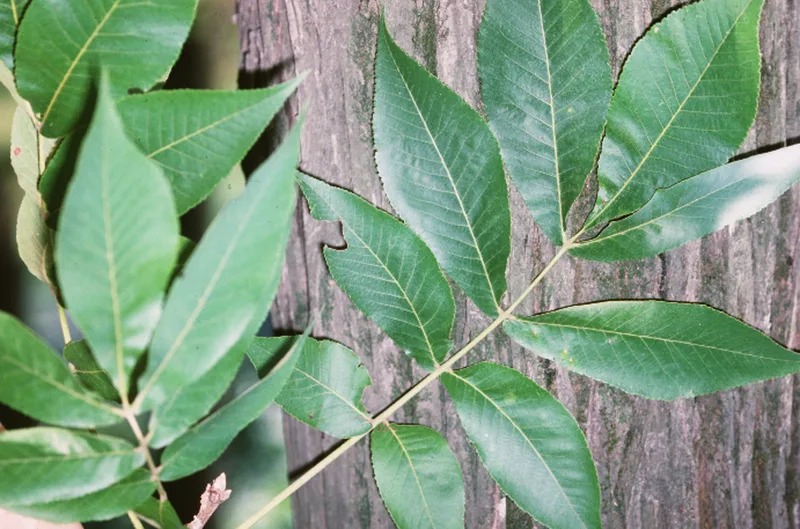
Shellbark Hickory (Carya laciniosa) showing shaggy bark, compound leaves, and mature nuts
Carya laciniosa — the shaggy exfoliating bark, pinnately compound leaves, and the largest nuts of any hickory. Photo: Rooted Revival.

Identification

[ field key — bark · leaf · nut · bud · comparison with Shagbark ]

Habit & Bark

A large, stately deciduous tree with a tall, straight trunk and a narrow to broadly oblong crown. The defining feature of mature trees is the shaggy bark: long, thick, vertically curling plates that peel away from the trunk in strips up to 2–4 ft long, giving the tree a wild, unkempt appearance. Unlike the closely related Shagbark Hickory (Carya ovata), Shellbark bark plates are longer, broader, and less numerous, and the trunk itself tends to be proportionally wider. Young trees have smooth, light gray bark that begins peeling into plates at around 15–20 years. The twigs are stout, with an orange-brown to tan color and prominent leaf scars; the terminal bud is large (to 1 in), yellowish to brown, and covered with a few loose, pubescent outer scales.

Leaves

Alternate, odd-pinnately compound, typically 15–24 in long, with 7 (occasionally 5 or 9) leaflets. Leaflets are obovate to lanceolate, 4–8 in long, sharply serrate, dark green and glabrous above, paler and densely pubescent (soft-hairy) beneath — a key character separating Shellbark from Shagbark Hickory, whose leaflets are essentially glabrous underneath. The rachis (central leaf stalk) is stout and typically pubescent. Fall color is a dependable golden-yellow to warm brown.

Nut & Husk

Shellbark produces the largest nuts of any hickory — 1.5–2.5 in long, oblong to nearly spherical, enclosed in a very thick (to 1/2 in), four-ribbed husk that splits to the base at maturity. The nutshell itself is thick, bony, and light tan to whitish (hence "shellbark"), requiring a heavy nutcracker or hammer to open. The kernel, once freed, is rich, sweet, and considered the finest-tasting of all hickory nuts — superior even to the more common Shagbark Hickory. Nuts are produced singly or in clusters of 2–3 and ripen in September through October, dropping soon after the husk splits.

Comparison with Shagbark Hickory

The two shaggy-barked hickories are frequently confused. Key differences: Shellbark has 7 leaflets (Shagbark typically 5), leaflets are pubescent beneath (Shagbark glabrous), the nut is larger with a thicker husk, and the bark plates are longer and wider. Shellbark also has a strong preference for bottomland, alluvial soils, whereas Shagbark tolerates drier upland sites. The terminal bud of Shellbark is larger and more yellowish than that of Shagbark.

Habitat & Range in NE Oklahoma

Carya laciniosa is a species of bottomland forests, river floodplains, and rich alluvial terraces across the central and eastern United States. Its range extends from western New York and southern Ontario south to northern Georgia and Alabama, west through the Ohio and Mississippi valleys to Iowa, eastern Kansas, eastern Oklahoma, and eastern Texas. In NE Oklahoma, it is found almost exclusively in the deep, fertile soils of major river bottoms — particularly along the Arkansas, Verdigris, and Grand (Neosho) River systems — where it grows in association with American Sycamore, Eastern Cottonwood, Green Ash, Sugarberry, American Elm, and other bottomland hardwoods.

Shellbark Hickory is an obligate bottomland species in our region: you will not find it on upland sites, and attempts to plant it on dry, compacted, or thin soils will result in slow growth, chronic stress, and early decline. It is uniquely adapted to the seasonal flooding regimes of rich alluvial floodplains, where its deep taproot accesses stable moisture below the flood-pulse zone and its thick, shaggy bark provides some resistance to fire and mechanical damage from floating debris. Within the Tulsa region, wild populations are scattered and uncommon, primarily confined to the larger river corridors and their mature bottomland forest remnants.

Ecology & Wildlife Value

[ mast producer · lepidoptera host · cavity habitat · bottomland keystone ]

Mast for Wildlife

Shellbark Hickory nuts are a critical fall and winter food source for a wide range of wildlife in bottomland forests. Eastern gray squirrels and fox squirrels are the primary mammalian dispersers, caching nuts in scattered hoards that aid natural regeneration. Other mammalian consumers include chipmunks, white-tailed deer, raccoons, and opossums. Among birds, wild turkeys, wood ducks, blue jays, red-bellied woodpeckers, and various other species feed heavily on hickory nuts when available. The thick shell excludes some smaller seed predators but the large nut size makes it a high-value reward for those that can crack it.

Lepidoptera Host

Hickories in the genus Carya are among the most important larval host genera for eastern North American Lepidoptera, supporting over 200 species of moths and butterflies. The most spectacular and famous is the hickory horned devil (Citheronia regalis), the enormous green caterpillar of the regal moth (royal walnut moth) — North America's largest caterpillar, reaching over 5 in long with fearsome-looking orange-and-black "horns." Other notable hickory-feeding Lepidoptera include the luna moth (Actias luna), the hickory tussock moth (Lophocampa caryae), and multiple species of prominent moths and underwings.

Cavity & Den Habitat

Old, large-diameter Shellbark Hickories, especially those that have sustained storm damage or woodpecker excavation, provide essential cavity and den habitat for a diverse community of animals. Wood ducks, barred owls, screech owls, great crested flycatchers, and multiple woodpecker species nest in hickory cavities. The shaggy bark itself creates microhabitat for brown bats (especially during migration), tree frogs, anoles, and a host of bark-dwelling insects and spiders. Large dead snags (standing dead trees) are particularly valuable and should be retained where safe to do so.

Riparian Ecosystem Services

As a deep-rooted, long-lived canopy tree in bottomland settings, Shellbark Hickory provides substantial riparian ecosystem services: its root system stabilizes stream banks and floodplain soils, its leaf litter contributes to aquatic detrital food webs, its shade moderates water temperatures in adjacent streams, and its large canopy intercepts rainfall and reduces flood-pulse energy. In agroforestry contexts, a row of Shellbarks along a river or creek provides both nut production and conservation value simultaneously.

Permaculture role: Canopy nut tree / long-term investment. Shellbark Hickory occupies the top tier of a riparian food forest. Understory compatible species include Pawpaw (tolerates the juglone-like compounds hickories produce at lower levels), Spicebush, American Elderberry, and shade-tolerant wildflowers. Because hickories are relatively slow to begin bearing (10–15 years from planting a nursery-grafted tree), plant them alongside faster-yielding species (persimmon, mulberry, plum) that will produce while the hickory matures.

Horticulture & Care

[ site selection · planting · nut harvest · grafting · cultivars ]

Site selection & planting

Shellbark Hickory demands deep, rich, consistently moist soil. In NE Oklahoma, this means bottomland terraces along creeks and rivers, or artificially irrigated deep garden soils. Do not plant this tree on compacted clay subsoil, drought-prone uplands, or thin soils over bedrock — it will survive for a few years and then decline. The ideal site is a floodplain terrace or lower slope with alluvial silt loam, a water table within 4–8 ft of the surface, and full sun exposure (or at minimum 6+ hours). Plant 1–2 year-old bare-root or container-grown trees in late winter to early spring. Dig a hole 2–3x the width of the root system and only as deep as the root collar. Do not plant too deep; the root flare must be at or slightly above grade.

Nut production & harvest

Seed-grown Shellbark Hickories typically begin bearing at 15–25 years of age; grafted trees may begin at 8–12 years. Trees are monoecious (separate male and female flowers on the same tree) and wind-pollinated. Heavy nut crops occur every 2–3 years, with lighter production in intervening years. For consistent pollination and nut set, plant at least two genetically distinct trees within 200 ft of each other. Nuts mature in September–October and fall soon after the thick green husk splits. Gather daily from the ground before squirrels claim the crop; remove husks promptly (wear gloves — they stain). Cure nuts by spreading in a single layer in a warm, dry, well-ventilated location for 2–3 weeks before cracking.

Grafting & cultivar selection

Because seedling hickories vary substantially in nut quality, kernel yield, and bearing age, serious nut growers graft named cultivars onto seedling rootstock. Hickory grafting is notoriously difficult compared to pecan; bench grafting in late winter or bark grafting in spring are the most common methods. Selected Shellbark cultivars include:

Cultivar Nut quality Cracking characteristics Notes
'Fayette' Excellent flavor; large kernel Moderate shell thickness; cracks in halves Proven performer; widely available grafted
'Henry' Very good; sweet and rich Thinner than average; easy crack Reliable cropper; moderately precocious
'Keystone' Good; somewhat mild Medium-thick; decent kernel recovery Heavy producer; consistent annual bearing
'Lindauer' Excellent; large sweet kernel Thick shell; cracks with difficulty Superb flavor but hard to crack; worth the effort
'Ross' Very good; rich hickory flavor Medium shell; fair crack-out Good all-around home orchard cultivar

Pests & diseases

Edible & Cultural Uses

Shellbark Hickory nuts have been prized by Indigenous peoples across eastern North America for millennia. The nuts were gathered in fall, cured, and stored whole or cracked and rendered into hickory nut oil, meal, and milk. The thick shells could be stored for long periods without spoilage, making hickory nuts a reliable winter staple. The nutmeats were eaten raw, roasted, pounded into a paste, or boiled to extract a rich, flavorful "milk" (similar to how modern cooks make almond milk) that was used as a base for soups, stews, and beverages. Crushed nuts, shells and all, were boiled to make hickory nut soup or stew, a traditional dish among several Eastern Woodlands and Southeastern tribes.

Sources & Further Reading

Hero photo: Rooted Revival.