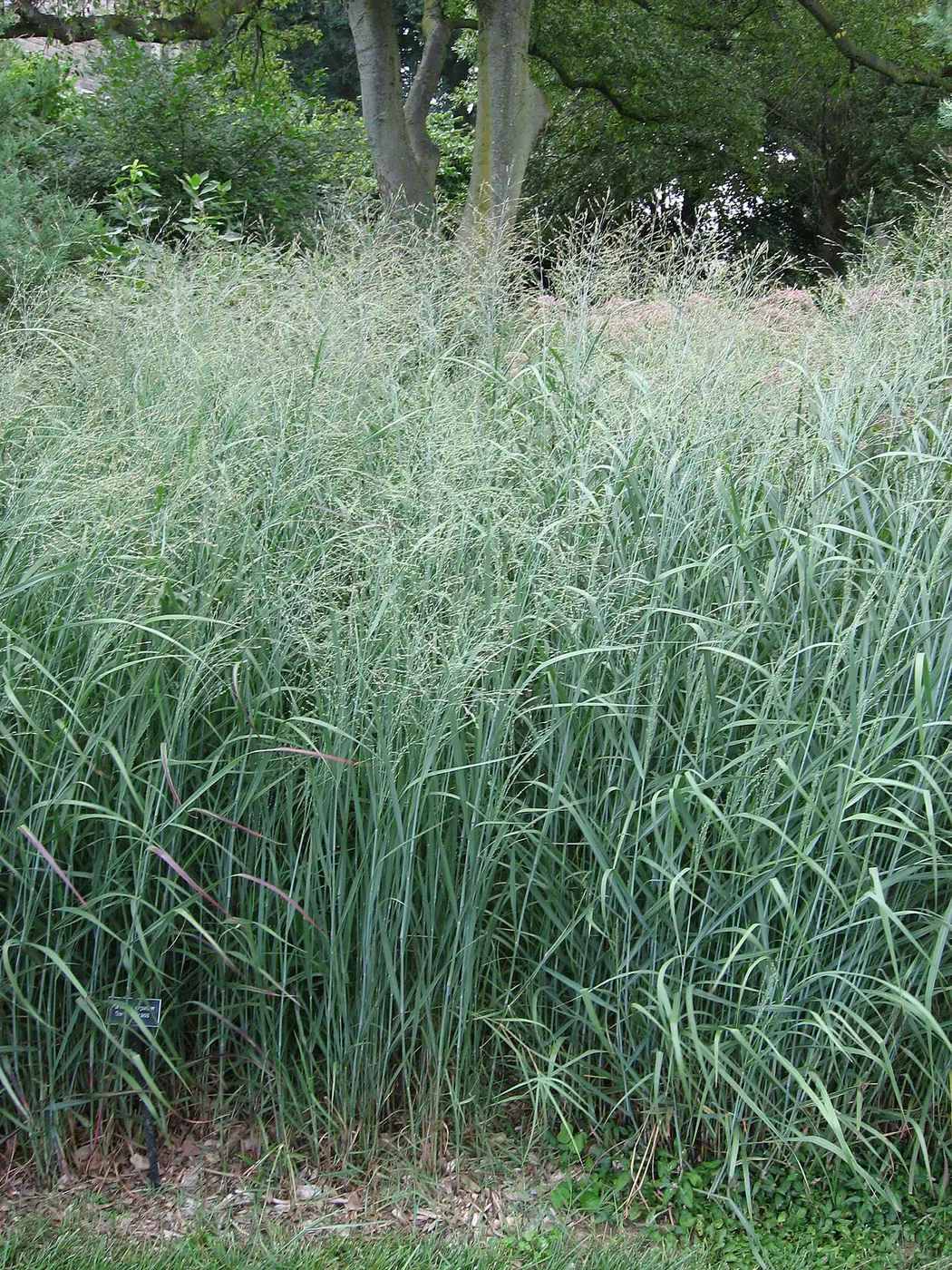
Horticulture & Care
[ planting · soil · water · cutback · burning · cultivars ]
Site selection & planting
Plant in spring, after the soil has warmed — switchgrass
is a warm-season C4 grass and will not establish well in cold soil. Container
stock can be set out from April through early summer; for direct seeding, wait
for soil temperatures of 60 °F+. Choose a site with full sun (6+
hours); in light shade plants persist but flop and bloom poorly.
Switchgrass tolerates the full range of NE Oklahoma soils — sand to
heavy clay, pH 4.9–7.6 — and the full range of soil moisture from
seasonally flooded bottoms to dry upland slopes.
- Spacing: 24–36" on center for landscape clumps; matrix plantings as close as 18".
- Hole: just deep enough to set the crown level with the soil — never bury the crown.
- Backfill: native soil only; do not amend, do not fertilize at planting.
- Mulch: light shredded hardwood, kept thin and away from the crown.
- Water deeply 1×/week through the first growing season; thereafter on rainfall.
Water, fertility & weed competition
Once established (typically by the end of year 2), mature switchgrass is
essentially drought-proof in the Tulsa region thanks to its
6–10 ft root system. It is also a famously light feeder —
avoid lawn fertilizer drift, which causes lodging (the clump falls over). For
seeded prairie restorations, first-year stands often look weedy; this is
normal and switchgrass typically out-competes annual weeds in years 2–3
with no chemical intervention.
Cutback & controlled burning
Cut clumps to 4–6" above the crown in late winter
(February in Tulsa), before new growth pushes from the base. The standing
winter form is one of the best ornamental features of the species, so resist
the temptation to cut back in fall. On larger plantings, a
controlled burn every 2–3 years in late winter both
cleans out thatch and stimulates more vigorous flowering — this is the
historic prairie fire regime switchgrass is adapted to.
Propagation
-
Seed: Collect mature panicles October–November, rub
off the caryopses, and either sow immediately on the soil surface
(overwinter stratification) or store dry and sow after 6–8 weeks
cold-moist stratification in spring. Plant 1/4–1/2" deep into a firm
seedbed; pack soil before AND after seeding for good seed-soil contact.
Germination is typically 50–70% on stratified seed.
-
Division: Lift mature clumps in early spring just as new
growth emerges, slice into wedges with a sharp spade, and replant.
Reliable; the standard method for propagating named landscape cultivars
that do not come true from seed.
-
Plugs: Commercial nurseries grow improved cultivars from
tissue culture or division and sell them as 4" plugs — the easiest
option for landscape installs.
Pests & diseases
-
Switchgrass rust (Puccinia emaculata) —
cosmetic in landscape settings; an active research target for biofuel
breeders.
-
Lodging — floppy clumps are almost always caused by
excess fertilizer, irrigation overspray from adjacent lawns, or shade.
Move the plant or stop the input rather than staking it.
-
Voles — occasionally girdle crowns under winter
snow; not a meaningful pest in NE OK.
Notable cultivars for NE Oklahoma
| Cultivar |
Type |
Distinguishing feature |
Notes for Tulsa |
| 'Heavy Metal' |
Landscape |
Steel-blue glaucous foliage, strictly upright 3–5 ft |
The standard blue-leaf switchgrass; RHS Award of Garden Merit. Excellent in modern, formal plantings. |
| 'Northwind' |
Landscape |
Very upright, narrow, 4–6 ft; olive-green foliage |
Most upright cultivar — the "exclamation point" grass. Stays vertical even after Oklahoma thunderstorms. |
| 'Shenandoah' |
Landscape |
Red-tipped foliage by July, deep burgundy fall color, 3–4 ft |
Best red-leaf switchgrass for NE OK; pairs beautifully with russet sedges and asters. |
| 'Cloud Nine' |
Landscape |
Giant 6–8 ft; blue-green foliage; massive panicles |
Use as a privacy screen or vertical anchor; needs full sun and elbow room. |
| 'Dallas Blues' |
Landscape |
Wide steel-blue blades, large pink panicles, 4–5 ft |
The heaviest-blue switchgrass; RHS Award of Garden Merit. |
| 'Cape Breeze' |
Landscape |
Compact 2–3 ft; salt & humidity tolerant |
For tighter beds, parking strips, or where 'Heavy Metal' is too tall. |
| 'Alamo' |
Lowland forage / biofuel |
Tall, coarse, very high biomass; southern lowland ecotype |
The standard lowland cultivar for southern-tier biofuel and forage trials — widely studied in OK/TX. |
| 'Kanlow' |
Lowland forage / biofuel |
Tall (6–8 ft), wet-tolerant, flood-tolerant lowland ecotype |
Workhorse for riparian-buffer plantings on bottomland and pond margins. |
| 'Cave-in-Rock' |
Upland forage / conservation |
Mid-tall upland ecotype; hardy and reliable |
USDA-NRCS workhorse for CRP and grass-waterway plantings across the central U.S. |
| 'Trailblazer' |
Upland forage |
Improved digestibility selection from 'Pathfinder' |
Cattle-pasture cultivar; bred at the USDA grassland research program. |
Landscape design note: For NE Oklahoma residential and
commercial sites, choose 'Northwind' for strictly vertical
structure, 'Heavy Metal' for blue glaucous foliage,
'Shenandoah' for red autumn color, and
'Cloud Nine' for screen-height plantings. Reserve 'Alamo',
'Kanlow', 'Cave-in-Rock' and 'Trailblazer' for forage, riparian-buffer or
biofuel plantings — they are taller, coarser, and less ornamentally
refined than the named landscape cultivars.
Companion planting in a prairie meadow
Pairs naturally with the rest of the Big Four (big bluestem,
little bluestem, indiangrass) plus a forb layer of
compass plant (Silphium laciniatum),
gayfeather (Liatris spicata / L. punctata),
purple coneflower, black-eyed Susan,
wild bergamot, aromatic aster and any of the
native Solidago goldenrods. For riparian-buffer plantings, combine
with eastern gamagrass and sedges (Carex spp.) on the wettest band,
switchgrass on the moist middle band, and little bluestem on the dry upland
band.