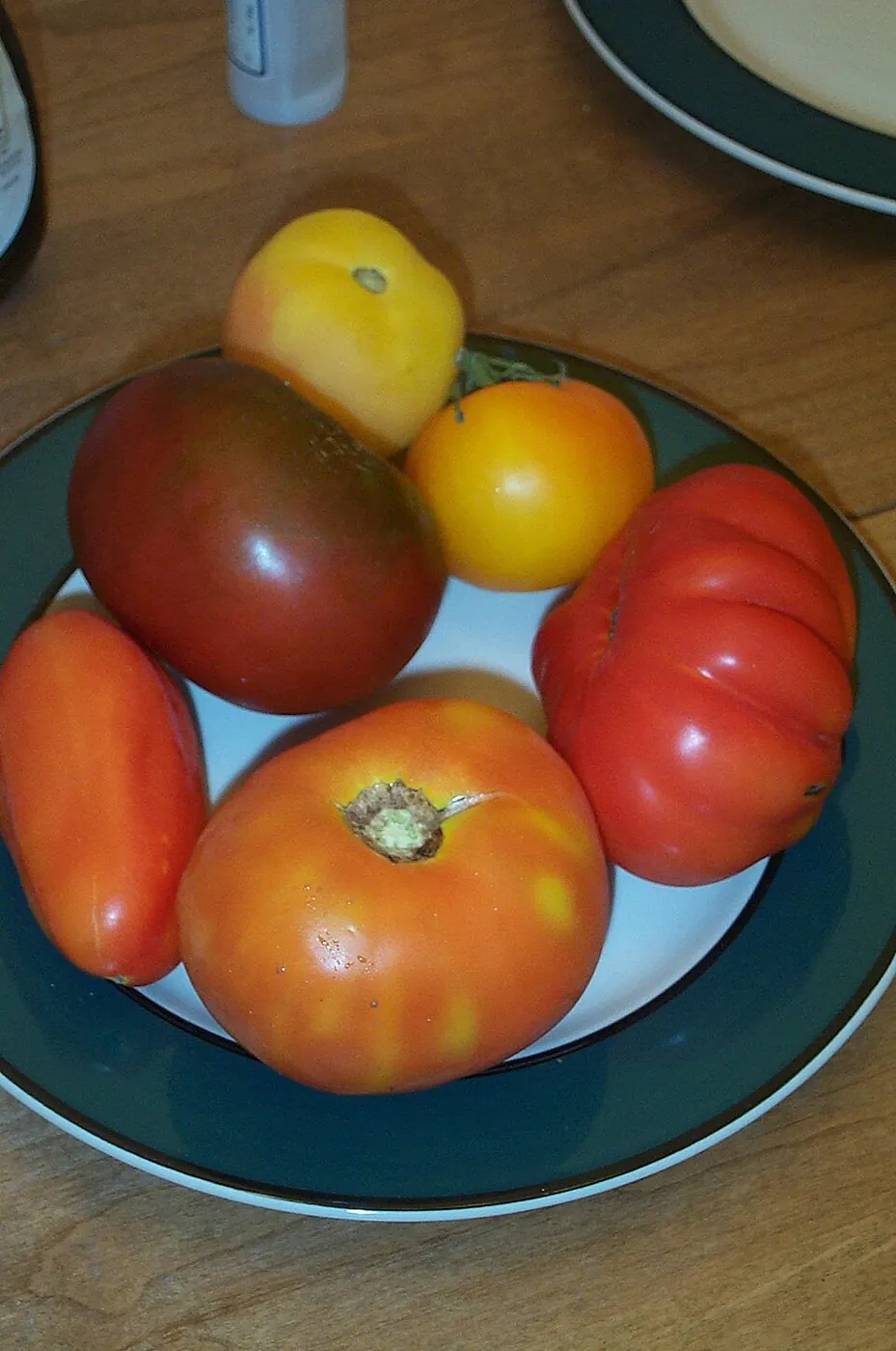
Horticulture & Care
[ planting · soil · water · staking · pests · diseases ]
Site selection & planting
Choose the sunniest spot in the garden — 8+ hours of direct sun.
Tomatoes are heavy feeders and need deep, fertile, well-drained soil amended with
2–4" of finished compost worked in before planting. Slightly acidic soil
(pH 6.2–6.8) is ideal; Tulsa-area clay benefits from gypsum
and organic matter to improve structure. Rotate the tomato bed on
a 3–4 year cycle to break Solanaceae-specific soil disease pressure (early
blight, Verticillium, Fusarium); never plant tomatoes where peppers, eggplant or
potatoes grew the previous year.
- When: Transplant after last frost & soil > 60 °F at 4" depth — ~April 15–30 in Tulsa.
- How deep: Bury the stem up to the lowest set of true leaves — tomatoes form adventitious roots all along the buried stem.
- Spacing: Determinate 24"; indeterminate caged 36", staked 18–24".
- Mulch: 3–4" of straw or wood chips immediately, kept off the stem.
- Support: Install cages or stakes at planting — later disturbs roots.
Determinate vs Indeterminate — the rule that decides everything
Determinate cultivars are bush-form, top out around 3–4 ft,
and produce nearly all of their fruit in a single concentrated 2–3 week
window. They need only modest support (a small cage), should
not be heavily pruned (every removed sucker = lost fruit), and
are ideal if you want a single big harvest for canning — classic
determinate cultivars include 'Roma', 'Celebrity',
'Rutgers' and most modern paste tomatoes.
Indeterminate cultivars vine indefinitely, will exceed 6–12
ft on a stake by August, and produce continuously until frost. They
require strong support (heavy cages, Florida weave, or single
stakes with weekly tying), benefit from removing suckers (the
shoot in the leaf axil) on the lower 2–3 stems for airflow, and are the
better choice for a long fresh-eating season. Most heirlooms are
indeterminate, including 'Cherokee Purple', 'Brandywine', 'Black Krim' and
'Arkansas Traveler'.
Water & blossom end rot
Tomatoes need 1–2 inches of water per week, applied
deeply and consistently at the base of the plant. Drip or soaker hose is
ideal; overhead watering wets foliage and accelerates leaf disease. Irregular
watering — deep soak / drought / deep soak — is the leading cause of
blossom end rot, the dark sunken patch on the bottom of the
fruit. BER is not usually a calcium deficiency in the soil;
Oklahoma soils contain abundant calcium. It is a calcium uptake
failure caused by inconsistent water (the plant can't transport calcium
in the xylem fast enough during a growth spurt). The fix is even moisture
and mulch, not adding lime or eggshells.
Diseases & integrated management
-
Early blight (Alternaria solani) — brown bullseye
spots starting on lower leaves; the most common foliar disease in OK.
Manage with mulch (blocks soil splash), drip watering, lower-leaf removal,
and 3-year rotation.
-
Septoria leaf spot — tiny dark spots with yellow halos;
same management as early blight.
-
Late blight (Phytophthora infestans) — less
common in OK than the humid Northeast but devastating in cool wet years;
no organic cure once established, plants must be removed.
-
Fusarium & Verticillium wilt — soil-borne, persist for
years; rotate and choose resistant cultivars (resistance codes V, F, FF, FFF
on hybrid labels — most heirlooms have no resistance).
-
Tomato spotted wilt virus — vectored by thrips; remove and
destroy infected plants.
-
Cracking — concentric or radial; caused by a heavy rain after
drought. Choose crack-resistant cultivars ('Arkansas Traveler' is
exemplary).
Notable heirloom & classic cultivars for NE Oklahoma
| Cultivar |
Type |
Origin / breeder & year |
Notes for Tulsa |
| 'Arkansas Traveler' |
Indeterminate · pink · ~80 days |
Ozarks, late 1800s; popularized by Univ. of Arkansas pre-1968 |
Top OK heirloom. Heat-set, crack- & disease-tolerant; 6–8 oz pink fruit. Built for our climate. |
| 'Cherokee Purple' |
Indeterminate · purple-black · 80–90 days |
Tennessee, said to originate with the Cherokee ~1890; named & introduced by Craig LeHoullier 1990 |
The SE-US heirloom standout; legendary smoky-sweet flavor; reasonably heat-tolerant for an heirloom. |
| 'Brandywine' (Sudduth's strain) |
Indeterminate · pink · 90–100 days · potato-leaf |
Pennsylvania Amish, documented 1885 |
The classic flavor benchmark, but late and heat-stressed in OK; site with afternoon shade and mulch heavily. |
| 'Black Krim' |
Indeterminate · dark purple-brown · 75–90 days |
Crimean Peninsula, pre-1990 |
Heat- and drought-tolerant; rich flavor with a saline note; good OK performer. |
| 'Mortgage Lifter' |
Indeterminate · pink · 85 days |
M.C. "Radiator Charlie" Byles, Logan WV, 1930s |
1–2 lb pink fruit; Byles famously sold seedlings for $1 each in the Depression and paid off his $6,000 mortgage. |
| 'Roma' |
Determinate · red paste · 75 days |
USDA, 1955 (open-pollinated, often considered heirloom) |
The standard paste tomato; low-juice, meaty, ideal for sauce & canning. |
| 'Pink Berkeley Tie-Dye' |
Indeterminate · pink/green striped · 75 days |
Brad Gates / Wild Boar Farms, dehybridized ~2010 |
Modern "neo-heirloom" — a stable open-pollinated line bred from a hybrid; striking fruit, complex flavor. |
| 'Better Boy' (F1 hybrid — not heirloom) |
Indeterminate · red · 70–75 days |
Petoseed, 1975 |
Listed for comparison: classic VFN-resistant hybrid, very productive in OK, but seed will not come true. |
| 'Sungold' (F1 hybrid — not heirloom) |
Indeterminate · gold cherry · 60 days |
Tokita Seed, Japan, 1992 |
The benchmark cherry tomato — tropical-fruit sweetness; F1 only, save seed and you'll get something else. |
Heirloom vs F1 Hybrid — what the labels mean
An heirloom is an open-pollinated cultivar —
its seed, planted next year, will produce plants essentially identical to its
parent. There is no firm cutoff, but most seed-saving organizations use
~50 years old as a rough boundary. An F1 hybrid is the
first-generation cross between two distinct inbred parent lines; F1 plants are
uniform and often vigorous (hybrid vigor), but their saved seed
(F2) segregates into a wild mix of grandparent traits. F1s often carry
useful disease-resistance genes that heirlooms lack — the trade-off is
flavor depth and seed sovereignty. Both have a place; serious
seed savers grow heirlooms.