Horticulture & Care
[ planting · soil · water · pruning · spread management ]
Site selection & planting
Plant container or bare-root divisions in fall or early spring, or
sow seed directly on a prepared site in late fall to take advantage of natural
winter stratification (seed needs ~30 days of cold-moist chilling for high
germination). Choose a full-sun location — 6 hours minimum,
more is better. The plant is essentially soil-indifferent: it succeeds on heavy red
clay, thin rocky upland, sandy loam, and reclaimed disturbed ground alike. It does
not tolerate poor drainage or chronically wet feet.
- Spacing: 2–3 ft between plants; they will fill in within 2 seasons.
- Backfill: native soil; do not amend — rich soil promotes flopping.
- Mulch: light wood-chip mulch the first season; not needed once established.
- Water: deep weekly water for the first summer only; rainfall thereafter.
- Companions: tall warm-season grasses (big bluestem, indiangrass) help support stems and prevent flopping.
Managing the spread
This is the single most important horticultural fact about H. maximiliani:
it is aggressively rhizomatous. A single planting will, within
3–5 years, expand into a dense colony 6–12 ft across, and will continue
to push outward indefinitely. In appropriate sites — large pollinator meadows,
naturalized pasture edges, hellstrip plantings, restored prairie — this is
exactly what you want. In small formal gardens, it will swallow neighboring
perennials within a few seasons. Options to contain it:
- Root barrier: 18-inch deep vertical barrier (rhizome-grade bamboo barrier or buried metal edging) installed at planting.
- Annual edge spading: sever expanding rhizomes with a sharp spade around the desired footprint each spring.
- Mowing rim: a regularly mowed lawn or path on all sides will halt rhizomatous spread.
- Skip it entirely in tidy formal beds — choose a clump-forming sunflower like H. salicifolius 'First Light' or H. angustifolius 'Gold Lace' instead.
Pruning & flop control
In rich garden soil or with extra irrigation, stems can reach 9–10 ft and flop
badly under their own weight, especially after October thunderstorms. The standard
"Chelsea chop" applies: cut all stems back by one-third to one-half in
early to mid-June. The plants respond by producing shorter (4–6 ft),
stockier, more densely branched stems that bear nearly as many flowers and almost
never flop. After the first hard freeze, leave stems standing through winter for
wildlife, then cut to the ground in late February.
Forage, conservation & biofuel uses
Beyond ornamental and pollinator-garden use, H. maximiliani is one of a
small number of native perennials with documented agricultural
applications:
-
Livestock forage: USDA-NRCS rates the early-season foliage as
high-quality forage for cattle and sheep — protein content of young
regrowth rivals alfalfa. Used in mixed-species pasture and CRP cover seedings
across the southern Plains.
-
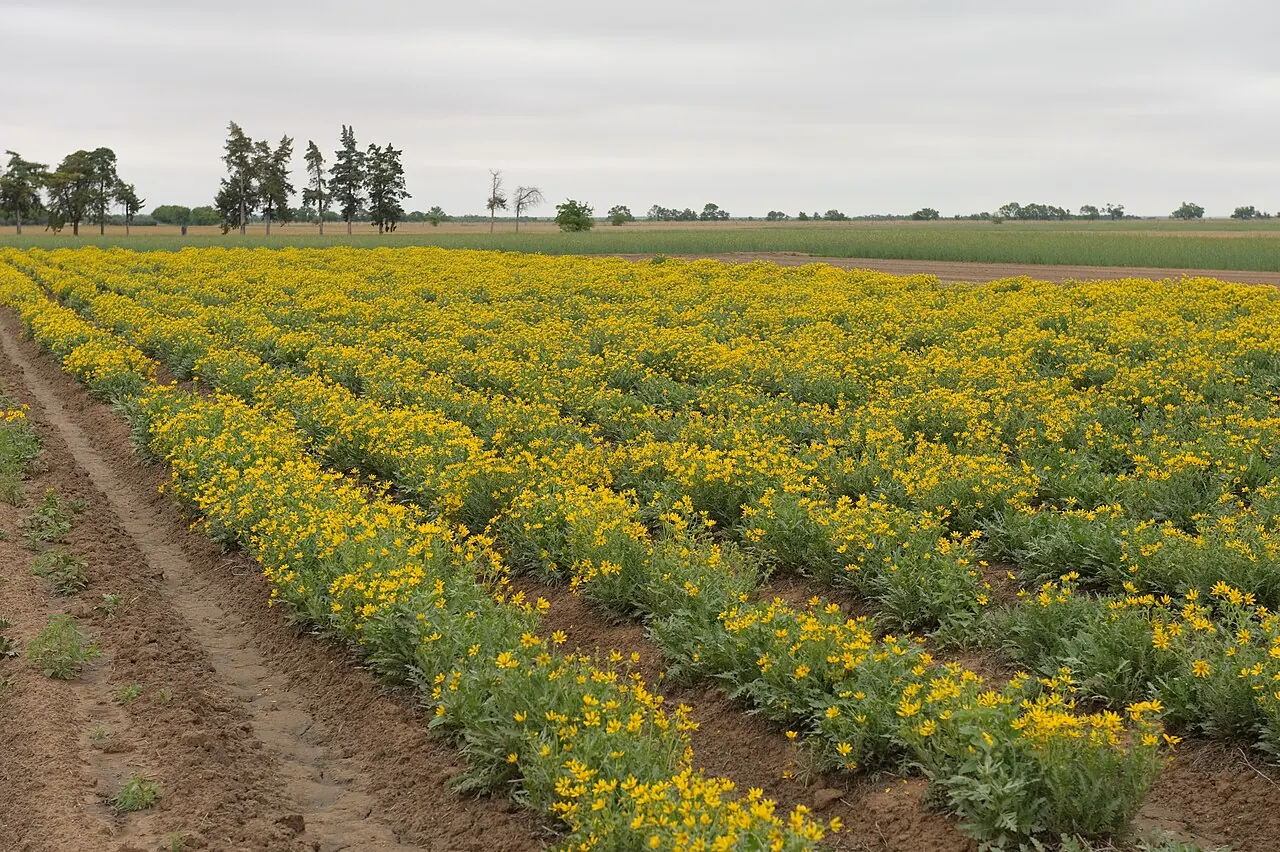
Soil & erosion conservation: the deep, dense rhizome mat is
excellent at stabilizing roadside cuts, swales, and reclaimed mine and pipeline
rights-of-way. NRCS Plant Materials Centers (notably Knox City, TX and Manhattan,
KS) maintain regional ecotype seed releases such as
'Aztec' and 'Medicine Creek'.
-
Biofuel & biomass research: high standing biomass, deep
perennial root system and minimal input requirements have made it a candidate
feedstock in cellulosic-ethanol and prairie-polyculture biomass studies (e.g.
the Tilman group's Cedar Creek work).
Cultivars & closely related native sunflowers
| Selection / species |
Type |
Distinguishing feature |
Notes for Tulsa |
| H. maximiliani 'Santa Fe' |
Cultivar |
Compact, ~5–6 ft; uniform habit; heavy bloom |
Best choice for residential pollinator beds with a little more room. |
| H. maximiliani 'Lemon Yellow' |
Cultivar |
Soft pale-yellow rays; slightly shorter |
Designer color; plays well with deep-purple aromatic aster. |
| H. maximiliani 'Aztec' |
NRCS release |
Texas/southern-Plains ecotype; tall, vigorous, late |
The standard for OK roadside and CRP seedings. |
| H. maximiliani 'Medicine Creek' |
NRCS release |
Northern-Plains ecotype; cold-hardy, upright |
Substitute if 'Aztec' is unavailable; still well-adapted to OK. |
| H. salicifolius (willowleaf sunflower) |
Related species |
Very narrow willow-like leaves, branched panicles, no rhizomes |
Clump-forming alternative for tight beds; same bloom window. |
| H. grosseserratus (sawtooth sunflower) |
Related species |
Coarsely toothed leaves, smooth red stems, wet-tolerant |
Use in low spots and rain gardens where Maximilian struggles. |
| H. angustifolius (swamp sunflower) |
Related species |
Narrow leaves, dark disk, late bloomer, moist soils |
Good companion for the wetter end of a fall-bloom border. |
| H. mollis (ashy sunflower) |
Related species |
Soft gray-fuzzy leaves, shorter (3–4 ft), midsummer bloom |
Pair with Maximilian to extend the sunflower season July–October. |
Fourth-quarter pollinator companion planting
For NE Oklahoma sites, the Rooted Revival "fourth-quarter" combination —
designed to peak from September through November when most gardens
have already shut down — pairs Maximilian sunflower with
prairie blazing star (Liatris pycnostachya) for late-summer
bridge bloom, aromatic aster (Symphyotrichum oblongifolium)
for October purple, and indiangrass (Sorghastrum nutans)
for the supporting golden-tan structure and seed value. This four-species core
covers monarch fall migration, late bumblebee queen provisioning, and winter
songbird seed in a single small planting.


.jpg)

.jpg)

