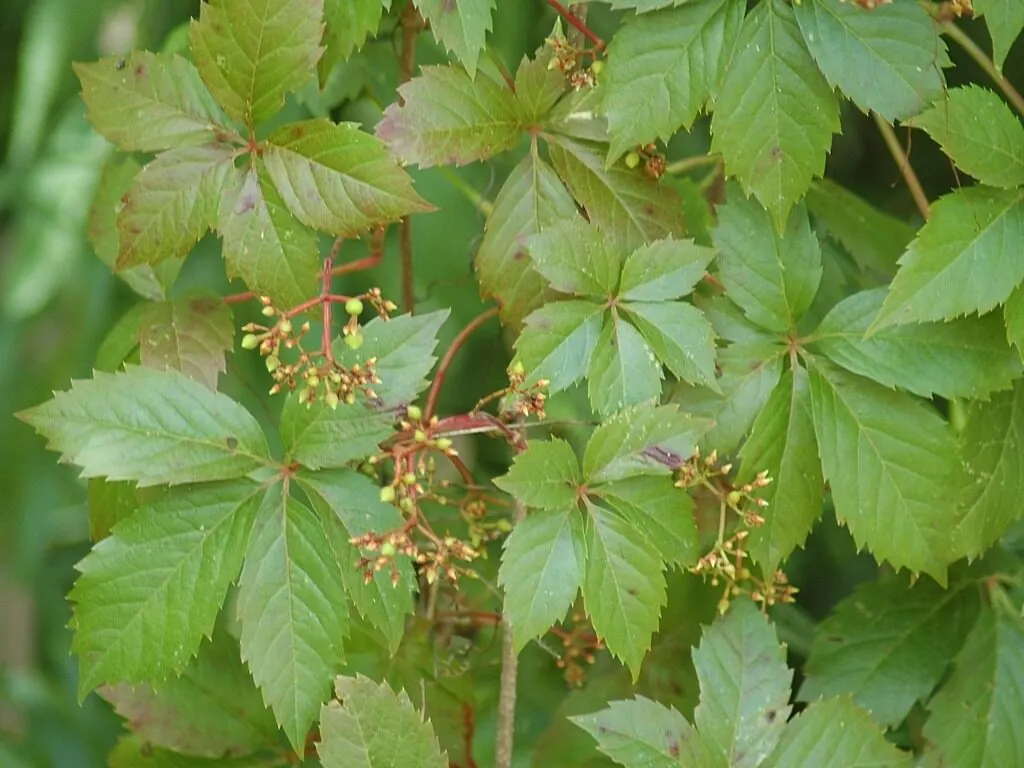
Horticulture & Care
[ siting · supports · managing vigor · cultivars ]
When to plant intentionally
Virginia creeper is a strong horticultural choice for: covering
unsightly chain-link fences and concrete walls, screening for
privacy, native fall-color displays, woodland-edge plantings, slope
stabilization on steep banks, and as a green roof candidate in some
installations. It is also an excellent vertical companion to a young
shade tree where the goal is rapid wildlife habitat development. Avoid
siting it on wooden siding, painted surfaces, or fragile lime mortar
where the adhesive disks can damage the surface on removal.
Planting & establishment
- Season: spring or fall; container-grown plants are
widely available and establish easily.
- Sun: full sun produces the strongest fall color and
the densest growth; deep shade produces sparser growth but acceptable
cover.
- Soil: tolerant of essentially any soil — sand,
clay, alkaline, acid, even compacted urban fill. Prefers moist
well-drained loam but is not particular.
- Hole: 2× rootball, same depth, no amendments.
- Spacing: 5–10 ft on-center for solid wall cover;
a single plant covers a small fence panel.
- Water: regular water through first growing season;
very drought-tolerant thereafter.
- Mulch: 2 in wood-chip ring — useful but not
required.
- Fertilizer: none ever; the plant's natural vigor is
already at the upper limit of garden use.
Supports & siting cautions
Virginia creeper attaches to almost any rough surface using its adhesive
tendril disks — brick, stone, masonry, concrete, rough-sawn wood,
and tree bark all work. Avoid: painted wood siding (the
disks lift paint when removed), aluminum siding (the disks may discolor
it), wooden shake roofs, and wood window-trim (the vine will work into
joints and lift them). On masonry it is essentially harmless to sound
mortar but should not be planted on old, soft historic-era lime mortar
where the disks can pry loose softened material.
Managing vigor
Virginia creeper is vigorous to potentially aggressive in
ideal conditions — in a moist, fertile, partly-shaded site it can grow
10–20 ft of new vine per year and seed itself prolifically into
beds and fencerows. To keep it in bounds: prune hard in late winter
(Feb), cutting back two-thirds or more of the previous year's growth and
removing tangled mats; pull out groundcover runners; and remove seedlings
in adjacent beds while they are small (deep rooted once 2 yr old). On a
building, prune back from window frames, gutters, and roof edges twice
yearly.
Pests & diseases
- Japanese beetle (Popillia japonica) skeletonizes
leaves in summer — cosmetic, sometimes severe.
- Leafhoppers cause mild stippling.
- Powdery mildew on shaded plants in damp summers.
- Largely deer-tolerant once established (browsed by deer when young).
- Generally trouble-free.
Notable cultivars
| Cultivar |
Distinguishing feature |
Notes for Tulsa |
| Straight species |
The genetic baseline; variable fall color |
The default choice. Tough, vigorous, the highest wildlife value. |
| 'Engelmannii' (Engelmann ivy) |
Smaller leaflets, finer texture, more restrained growth |
The choice for masonry walls where finer texture and slower growth are desired. Same fall color. |
| 'Star Showers' |
Variegated white-and-green leaves; pink in fall |
Slower-growing; needs partial shade; striking but reduced wildlife value. |
| 'Yellow Wall' |
Yellow rather than red fall color |
Unusual; pairs well with red-foliage species for autumn contrast. |
| 'Red Wall' (also sold as Troki) |
Selected for intense reliable scarlet fall color |
Excellent on a south-facing wall; fall display 2–3 weeks earlier than the species. |
Note: the closely-related Boston ivy
(Parthenocissus tricuspidata) is the OTHER common
"Parthenocissus" sold at garden centers — an Asian native with three-lobed
leaves rather than five leaflets. Both are non-invasive in OK; Virginia
creeper has higher wildlife value.